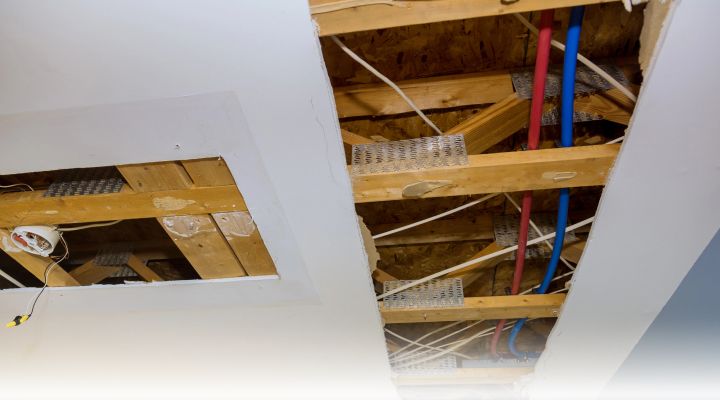
5 Reasons for Your Ceiling Stains (That Could Save You a $10,000 Roof Replacement)
One day, you notice a water stain on the ceiling, and it didn’t come from nowhere. Is this coming from the roof, or from a pipe somewhere above? They can look the same, but what’s causing them isn’t obvious.
Most of the time, it’s a hidden plumbing leak inside your walls or ceiling (a slow drip from a pipe or joint) that’s been seeping for weeks before it shows on your ceiling.
Roof vs. Plumbing & Why the Stain Isn’t the Source
So, what’s really going on up there? Usually, it comes down to two things: when the ceiling leak shows up and where it’s located.
Did you know: Water can travel up to 3 metres horizontally inside a ceiling cavity before dripping through, which means the stain you see and the leak source can be in completely different rooms.
Here in Ontario, those ceiling spots most often come from either a roof leak or a plumbing issue, and each has its own patterns depending on the season, your home’s layout, and local weather, such as ice dams and freeze-thaw cycles.
Spoiler: A water spot on the ceiling after rain usually means the problem is the roof.
But how do I know if the ceiling stain is the roof or pipes? Let’s compare!
–
Roof Leak
Plumbing Leak
When it appears
Usually, after rain or during a winter thaw
It’s constant and totally unrelated to the weather
Where it appears
On the top floor, near the eaves, or along exterior walls
Usually, below a bathroom, kitchen, or laundry room.
How it shows up
It gets worse after a storm and might dry out in between
It grows steadily, regardless of the season
How it looks
Often leaves behind brown or yellow rings
Usually lighter in colour, but can sometimes look grey
How it smells
Generally, it doesn’t
Can smell foul or musty (especially if it’s a drain line)
What it sounds
Silent most of the time, only drips when it’s wet outside
May drip continuously 24/7
How it affects your water bill
Your bill stays unaffected
Your bills are getting higher
Signs in the attic
Wet insulation or stained wood sheathing
Everything looks completely normal up there.
Local triggers
Watch for ice damming in the winter and early spring
Watch for pipe cracks during freeze-thaw cycles in late winter
So, is it a roof or plumbing leak? Unlike the former, plumbing leaks don’t care about the weather. They run whenever water flows through the system, and the only thing you can do is find the real culprit, and there are many possible ones.
Why the Real Culprits of Ceiling Water Stains in Your Homes Aren’t Obvious
So, you know the difference between plumbing and roof leaks, but what’s behind that brown stain on the ceiling? To answer this question, let’s delve into the most common causes.
Cause #1
It’s a Leak Inside Your Walls or Ceiling
Is your ceiling stain getting bigger day by day? You may never even see the leak since that little pipe joint or fitting inside your wall or ceiling can drip silently for weeks.
Why it happens: It’s all about the age. Joints loosen over time, fittings corrode, and even the strongest pipes deteriorate after decades of service. If your house is older, this happens faster.
What you notice: The first sign is a brown ring below your bathroom, kitchen, or laundry room, and the rain doesn’t account for it. The stain grows slowly and consistently. If you touch the drywall carefully, it might feel soft or slightly damp.
How to check: Turn off every tap and water-using appliance in your house. Then locate your water meter and watch the indicator. If it is spinning, you have a leak inside your pipes.
Why it gets worse: The leak won’t go away on its own, and if you don’t fix it, every hour more water soaks into your subfloor, joists, and insulation. By the time you notice it, the damage may cost you thousands of dollars.
So when you spot a stain, it might not just be a simple issue and that brown ring on the ceiling is a sign of water damage.
Cause #2
Something’s Leaking in Your Upstairs Bathroom
Is the leak in the ceiling above the bathroom? Unfortunately, it can be anything that uses the water.
Why it happens: Usually, it boils down to connections in upstairs bathrooms, like shower drains, sink traps, and toilet fittings. All of them can loosen over time, so even a tiny leak at a joint or drain flange can slowly seep through the subfloor.
What you notice: It starts with a brown ring or patch on the ceiling directly below your bathroom. Also, the stain might not be directly under the fixture because water can move along joists or under the flooring before it drips.
How to check: In this case, test your shower and toilet for leaks. To isolate a shower leak, pour a large bucket of water directly into the drain. As for a toilet, place a few drops of food colouring into the back tank (not the bowl). If the colour appears in the bowl or on the ceiling below after 30 minutes, then the real cause is obvious.
Why it gets worse: If the ceiling is dripping only when the shower is used, that’s because every time you use the fixture, more water escapes, and over time, everything below becomes saturated. If you don’t address the problem, it can lead to ceiling water damage, mould growth, and cost you thousands in structural repairs.
Did you know: A single leaky shower drain or toilet flange can release 5–15 litres of water per day, soaking your ceiling and subfloor day after day.
Cause #3
Old Galvanized or Copper Pipe Joints in Your Home
Some conclude that a water stain on the ceiling not raining must be plumbing. And they’re right! If your home was built before the 1980s, that brown stain on your ceiling could be just the tip of the iceberg.
Why it happens: Any pipe material naturally deteriorates over time, but with galvanized steel, this process happens faster because it rusts from the inside. Whereas copper pipes develop tiny cracks under stress, and all joints gradually lose integrity. This means a single leak rarely exists in isolation. In other words, your entire plumbing system may be at fault.
What you notice: If you see a brown stain under your bathroom or kitchen, lower water pressure, discoloured water in the morning, or a slowly rising water bill, then the problem is probably your old pipes.
How to check: Inspect your plumbing for corrosion, pinhole leaks, or damp spots near joints. If your pipes are hidden, a professional can use a moisture meter or infrared camera to detect water behind walls or ceilings.
Why it gets worse: The bad news is that replacing a single joint won’t fix the problem, because the issue is more complex and affects the entire plumbing network. Such leaks often escalate within months, leading to structural damage.
Did you know: If your home was built before 1980, your pipes are likely past their 40–50 year lifespan and may already have cracks, clogs, or leaks.
Cause #4
Your HVAC Unit’s Drain Is Leaking
Sometimes the ceiling stain isn’t coming from a pipe or the roof but your HVAC system.
Why it happens: Condensate lines can sometimes become clogged with algae, debris, or mineral buildup. Plus, if there are cracks, kinks, or loose connections, water might escape and dampen your drywall and insulation.
What you notice: If you see a brown or patchy stain under your air handler, AC, or condensate line, especially in summer, then the problem is probably a leaking or blocked condensate line.
How to check: Look at the drain pan underneath your HVAC unit. If there is standing water in this tray, your primary condensate line is clogged. Also, check the PVC “P-trap” near the unit for any visible cracks or loose couplings that may be dripping during the summer or humid winter days.
Why it gets worse: Such leaks don’t just disappear when you turn off the unit. Every time your AC or any other HVAC unit runs, which during summer can be most of the day, more water leaks. Over time, this leads to mould, weakened insulation, and drywall damage, all of which are really expensive to repair.
Did you know: Condensate drain clogs and drainage failures are common hidden causes of ceiling water stains, but are among the simplest to fix.
Cause #5
Hidden Moisture in Your Attic
Ceiling stain after rain, a plumber or roofer? In this case, the latter. But sometimes the problem might be the air trapped above your ceiling.
Why it happens: In Ontario, the extreme difference between warm, humid indoor air and cold attic surfaces, especially in winter, creates ideal conditions for condensation. When soffit vents are blocked, insulation isn’t sufficient, or vapour barriers are missing, moisture can get trapped and end up creating issues below.
What you notice: In this case, stains appear on top-floor ceilings, often irregular in shape, sometimes accompanied by damp insulation or a musty smell. Unlike leaks from the roof that show up after it rains, these stains tend to appear during chilly weather or when the indoor humidity is high.
How to check: On a very cold day, go into your attic with a flashlight and look at the underside of the roof deck. If you see white frost, ice buildup, or “black tea” staining on the wood, you are dealing with attic condensation caused by poor ventilation, not a plumbing leak.
Why it gets worse: Every time warm indoor air hits cold surfaces, more moisture builds up, gradually saturating your ceiling cavities. Over time, this can cause mould and structural damage, often long before any obvious leak appears.
Did you know:According to Health Canada, mould thrives wherever moisture is present and can grow behind ceilings or walls where water damage has occurred in as little as 24–48 hours. That’s why addressing the source of a ceiling stain is more important than covering it up
One Ceiling Stain Today, Another Tomorrow? Let’s Figure Out What’s Going On!
That brown spot on your ceiling didn’t appear for no reason, and the sooner you figure out what’s behind it, the less it costs to fix. Let’s find what’s causing it!
How You Can Actually Fix Your Ceiling Water Stain Once And For All
It’s easy to spot the stain, but fixing what’s causing it is what actually matters, and the right solution depends entirely on where the water is coming from. Every solution listed below requires a professional to fully assess your property. Let’s delve into them.
Solution #1. Whole-House Repiping as Long-Term Remedy
If a stain in your home, especially if it’s built before the 1980s, is due to a failing joint, then that joint is likely not the only issue. It’s just the first one that decided to make itself known! In this case, whole-house repiping may be the solution you need.
How it works: To get rid of ceiling stains, a plumber replaces your entire supply system, which includes every line, every joint, and, of course, every fitting with new copper or PEX piping, section by section. This is a complex job, but if done by an expert, it can be completed in 2–3 days.
You also eliminate low water pressure, discoloured water, and temperature fluctuations for good, instead of relying on ongoing emergency repairs.
What it solves: After repiping, every supply line in your home is brand-new. You’re no longer dealing with aging joints or internal corrosion that slowly reduces water pressure and leads to leaks.
Instead of fixing one issue after another, you get a system that works reliably, without new ceiling stains showing up over time.
Solution #2. Targeted Pipe Repair for Isolated Leaks
As you already know, not every ceiling stain means your whole plumbing system is failing. But to implement this solution, you should be sure that the problem is truly isolated.
How it works: As with whole-house repiping, a plumber inspects your pipes using pressure tests, moisture meters, and sometimes a camera to pinpoint the exact source of the leak. Once it’s located, the specialists repair or replace the damaged section and test the system again to ensure everything is watertight.
What it solves: This approach addresses isolated pinhole leaks, failing joints, and cracked fittings, but only if the rest of your plumbing is in good condition.
Solution #3. Plumbing Fixture Repairs for Upstairs Leaks
The ceiling leak above the bathroom, what to do? If it seems to worsen when someone showers or flushes, the culprit is almost always one of the bathroom fixtures.
How it works: In this case, the plumber checks each fixture one by one. They run the shower, toilet tank, sink traps, and supply lines while watching the ceiling below for any signs of moisture.
What it solves: Once the source is found, a plumber replaces a wax ring, reseals a shower or sink drain flange, or tightens a leaky water supply line connection. In short, they fix any fixture that’s quietly dripping water into your ceiling every time it’s used.
Did you know: A single leaky shower drain can release 5–15 litres of water daily into the ceiling and subfloor, often without any visible sign at the fixture itself, and stain blocking primer Kilz won’t fix that.
That Brown Stain on Your Ceiling Won’t Tell You What Caused It, But A Plumber Will
The most important thing you should know about ceiling stains is that they are almost never a one-time event. And they don’t just disappear. But you can prevent further damage if you act quickly.
The thing is that the longer it’s there, the more it’s going to cost you, and not just for fixing the leak. The real damage comes from what it does to your ceiling, subfloor, and the mould risk that builds up over time.
If you’re wondering how to paint over a water stain on the ceiling, unfortunately, cosmetic ceiling repair or ceiling tile replacement won’t help.
It’s always best to get a plumber in to assess not just the failed joint, but the system it belongs to. Let’s be frank, that assessment costs far less than the ceiling stain you’re looking at right now, even if you live in the rental property.
FAQ About Ceiling Stains You Wanted To Know About
My home was built in the 1970s, and I’ve had two ceiling leaks in three years. Is that normal?
It’s common in older homes, but it’s not “normal.” Multiple leaks usually mean your pipes are past their prime. If you think that one small patch will fix it, then the sad news is that it won’t. Consider whole-house repiping before the next ceiling stain appears.
My plumber found one leaking joint and fixed it. Why does my ceiling keep staining in new spots?
Even if your plumber fixes one leaking joint, new ceiling stains can appear because older pipes rarely fail in isolation. As you already know, galvanized steel corrodes along the whole line, and copper can develop pinhole leaks at multiple joints, so patching individual leaks can end up costing more than a whole-house repiping.
My ceiling has a brown ring, but it hasn’t rained in weeks. What’s causing it?
If it’s dry outside and the stain is below your bathroom, kitchen, or laundry room, your first suspect should be plumbing. And that little brown ring is usually associated with a leak from a pipe joint, wax ring, or supply line.
My ceiling only drips when someone showers upstairs. Is that definitely plumbing?
Have no doubts! If your ceiling reacts to the shower, toilet, or sink above, it’s coming from that bathroom, not the roof.
How long can a ceiling leak go unnoticed before it causes serious damage?
Longer than you’d like. Slow leaks can run for 3–6 months before showing up on your drywall. By then, the subfloor and insulation above may already be soaked, and in Ontario’s humidity, mould can start forming in as little as 24–48 hours. If not fixed fast, you may end up paying thousands of dollars.
You surely don’t think about your pipes until something goes wrong. A leak in the ceiling. A drop in water pressure. Rusty water is coming out of the tap. At first, it feels like separate issues. You fix one, then another. But these aren’t isolated problems you can keep patching—they usually point to one main culprit: your pipes.
If you’re asking, “Why did my water bill suddenly go up when nothing changed?”, then you’re not alone. It’s one of the most common plumbing complaints homeowners have in Ontario! But once you find a cause, you can fix it. To do so, let’s begin with the basics.
There are many reasons for low water pressure in the water heater or throughout your home. If the problem is due to the city’s water supply, like a broken water main, you’ll need to wait for the water company to fix it. However, if the issue is specific to your home, such as a leaking water pipe or a faulty pressure regulator, plumbing repairs can help fix the problem.