
Geothermal Heating and Cooling: Complete Guide for Canadians
If you’ve spent any time looking into home heating options in Canada, you’ve probably come across geothermal heating and cooling at some point.
Book Your Geothermal Consultation

If you’ve spent any time looking into home heating options in Canada, you’ve probably come across geothermal heating and cooling at some point.
Book Your Geothermal ConsultationUnlike conventional furnaces and air conditioners that rely on outdoor air temperatures, geothermal systems use the stable temperature beneath the earth’s surface to heat and cool your home efficiently in every season.
But what is geothermal, how does it work, how much does it cost, and does it make sense for your home?
Geothermal systems use the earth’s stable temperature to heat your home in winter and cool it in summer. Unlike a furnace that burns fuel to generate heat, or a traditional air conditioner that dumps heat outside, a geothermal system moves heat, so that you get year-round comfort that doesn’t depend on combustion, fluctuate with outdoor temperatures, or require natural gas. 
This type of system goes by a few names, such as geothermal HVAC, geothermal air conditioning, or simply a ground source heat pump. But they all refer to the same technology.
Below the frost line (roughly 1.5 to 2 metres down), ground temperatures across populated areas of Canada stay at a stable average of 4°C to 8°C year-round, regardless of what’s happening above ground. This temperature is constant and serves as an incredibly reliable energy source for the system.
To put it simply, a geothermal system circulates a water-based fluid through underground pipes called a ground loop.That fluid absorbs heat from the earth, carries it into the home, and a heat pump concentrates and transfers it to your living space.
In summer, the process reverses, and heat is pulled from your home and deposited back into the cooler ground.
There’s no combustion, no open flame, and no fuel tank. The system runs on electricity, but it produces significantly more energy than it consumes, typically 3 to 5 units of heat for every 1 unit of electricity used.
One of the biggest misconceptions about geothermal is that it’s only designed to keep you warm in winter, but it can also cool your home during the summer.

In winter, the ground loop fluid (which stays above freezing even in Canadian winters due to antifreeze additives) absorbs heat from the earth and carries it to the heat pump inside your home. The heat pump compresses that energy and distributes it through your ductwork or radiant floor system, making it a form of renewable heating technology.
Even when outdoor temperatures drop to -20°C or colder, the ground below the frost line remains stable. That’s a major advantage over air-source heat pumps, which lose efficiency as outdoor temperatures fall.

In summer, geothermal cooling works by reversing the cycle. The heat pump extracts heat from inside your home and transfers it into the ground loop, where the earth absorbs it.
Since the ground remains cooler than summer air temperatures, this process is highly efficient, often more so than conventional central air conditioning.
Once the system is installed, you could say you’re living in a geothermal house, relying on the stable temperature of the earth beneath your feet to keep your family warm through a harsh Ontario winter.ʼ
Basically, one geothermal system replaces both your furnace and your central AC. And you don’t have to maintain two separate systems.
A geothermal system is made up of a few key components that work together to heat and cool your home.
Let’s break down the installation cost of each system component:
| Component | Average Price | What It’s For |
| Boring / Ground Loop | • Horizontal: $15,000 – $32,000 • Vertical: $25,000 – $48,000+ | Transfers heat between your home and the ground using underground piping with water or antifreeze. |
| Ground Source Heat Pump (Indoor Unit) | $6,000 – $16,000 | Extracts heat from the ground loop and distributes heating or cooling throughout your home. |
| Ductwork | $2,000 – $8,000+ | Delivers heated or cooled air to different rooms across your home. |
| Communication Modules | $400 – $1,600 | Controls temperature settings, zoning, and system monitoring for better comfort and efficiency. |
| Accessories | $2,000 – $5,500 | Includes a flow center pump pack, cold-climate antifreeze, a pressure expansion tank, and heavy-duty flush valves and manifolds. |
| Storage System | $2,000 – $4,500 | Stores hot water and helps improve efficiency by reducing system cycling and supporting domestic hot water use. |
Note: Prices are estimated averages for typical 3- to 5-ton systems in a standard-sized home (roughly 1,500 to 2,500 sq. ft.).
Your property does not have to fit a specific layout to use geothermal. The right ground loop configuration depends on factors such as lot size, local soil and rock conditions, and whether a nearby pond or lake is available.

Here are the four main types of ground loops used in geothermal systems:
Geothermal heating has earned a reputation as one of the most efficient ways to heat and cool a home, and for good reason.
Let’s take a look at both the advantages and the challenges before deciding if it’s right for you:
| Factor | Clear Advantage You Get | Something You Should Know About |
| Your Monthly Bills | Once it’s up and running, it can dramatically reduce your monthly heating and cooling costs compared to traditional heating systems. | The trade-off is the higher upfront cost, which means it may take several years of energy savings for the system to pay for itself. |
| The Upfront Price | Government rebates and clean energy incentives can help reduce the upfront cost by thousands of dollars. | Even with available rebates, geothermal remains a major investment, with installation costs typically ranging from $20,000 to $50,000. |
| Eco-Friendliness | Geothermal uses the earth’s natural heat to warm and cool your home, producing no direct greenhouse gas emissions. | The system needs electricity to operate, so its environmental impact depends on how your local power grid generates it. |
| All-in-One Climate Control | One geothermal system can provide both heating and cooling, so you don’t need separate equipment. | To achieve maximum efficiency, the system must be properly sized and designed for your home’s heating needs. |
| How Long It Lasts | Geothermal heat pumps typically last 20 to 25 years, while underground ground loops can remain in service for 50 years or more. | The long lifespan adds value, but major component replacements can be more expensive than repairs on conventional HVAC systems. |
| Your Yard & Property | Geothermal systems can be adapted to different property types using horizontal, vertical, or other ground loop configurations. | Your yard is going to look like a construction zone for a few days since installation requires excavation or drilling. |
| Maintenance | Since the core infrastructure is buried safely underground, it’s completely protected from freezing Canadian winters, rust, and storm damage. | You can’t fix it yourself with a YouTube tutorial to save a few dollars. Routine checks and repairs must be handled by certified pros. |
It’s an excellent long-term investment for the right property, but it’s not the right choice for every situation.


The short answer: it depends on your home, lot, and location.
Here’s a more detailed explanation:
| System Type | Home Size & Tonnage | Average Cost Range | Property Requirements |
| Horizontal Loop | Under 2,200 sq. ft. (2 to 3 tons) Over 2,500 sq. ft. (4 to 5 tons) | $22,000 – $28,000 $28,000 – $32,000 | Requires 0.25 to 0.5+ acres of clear, flat, open land free of underground utilities or dense tree roots for trenching. |
| Vertical Loop | Under 2,200 sq. ft.(2 to 3 tons) Over 2,500 sq. ft. (4 to 5 tons) | $30,000 – $38,000 $38,000 – $48,000+ | Ideal for tight urban/semi-rural lots, heavily wooded yards, or properties where you want to preserve mature landscaping. |
| Pond / Lake Loop | Under 2,200 sq. ft. (2 to 3 tons) Over 2,500 sq. ft. (4 to 5 tons) | $18,000 – $24,000 $24,000 – $28,000 | Requires an adjacent, permanent body of water that is at least 8 to 10 feet deep at its lowest summer point to prevent freezing. |
| Open Loop | Under 2,200 sq. ft. (2 to 3 tons) Over 2,500 sq. ft. (4 to 5 tons) | $15,000 – $25,000 $25,000 – $35,000 | Requires an existing, high-flow water well system with excellent water quality and a reliable discharge area. |
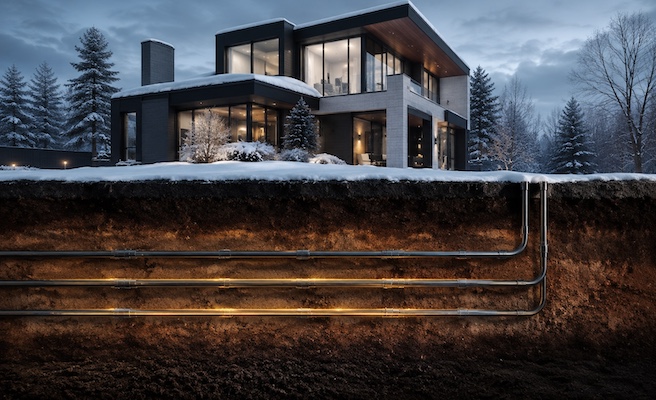
Discover how geothermal systems use the ground beneath your home to heat and cool more efficiently than any traditional system.
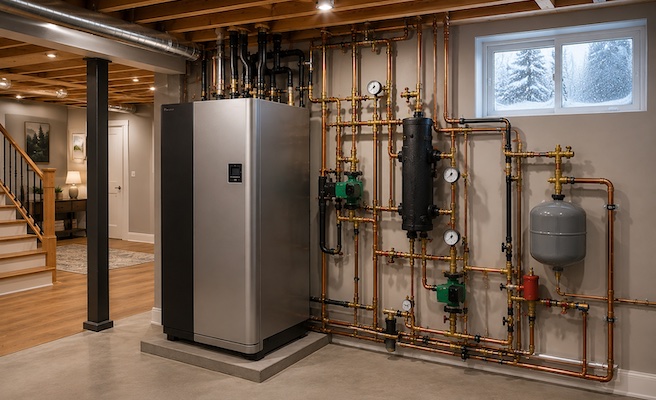
How ground source heat pumps work and which loop type is right for your property.
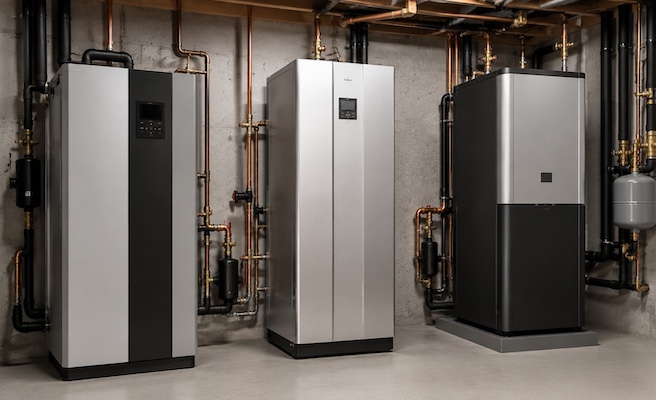
Planning to install geothermal?Planning to install geothermal? Start with our brand comparison guide to find the right system for your home.