If you’ve started researching geothermal heating, you’ve probably seen two very different opinions.
Some people claim it is the best heating and cooling system available, while others question the high installation cost and whether homeowners will actually see real long-term savings.
We break down the numbers, the savings, and the situations where geothermal makes sense for you, and where it doesn’t.
Upfront Cost vs. Long-Term Savings
Let’s start with the number that may stop you before you even read further, namely the installation cost. Installing a complete geothermal system in Ontario usually costs between $20,000 and $50,000. Surely, the price depends on your home size, lot type, and the loop system you need. For comparison, replacing a gas furnace and central air conditioner costs roughly $8,000 to $15,000 combined. So on day one, geothermal costs significantly more.
What You Save Each Year
A geothermal system can help you save a lot on energy bills, typically reducing heating and cooling costs by 30% to 70%, and cooling expenses by 20% to 50%, compared to traditional systems.
Home Setup
Estimated Annual Heating & Cooling Cost
With Geothermal
Annual Saving
Gas furnace + central AC (avg. home)
$2,800
$1,000 – $1,400
$1,400 – $1,800
Propane + central AC (rural home)
$4,500 – $6,000
$1,200 – $1,800
$3,000 – $4,200
Electric baseboard + window AC
$3,500 – $5,000
$900 – $1,400
$2,100 – $4,100
Oil furnace + central AC (older rural/suburban home)
$4,800 – $6,200
$1,200 – $1,800
$3,000 – $5,000
You save the most when you replace propane, oil, or electric baseboard, fuels that cost more per unit of heat than natural gas.
Available Incentives
Before you calculate your payback, remember to consider any available rebates. They can significantly change the total.
Incentive Program
Maximum Payout
Eligibility
Application Deadline
Learn More
Home Renovation Savings Program (HRS)¹
Up to $12,000
Available for first-time ground-source heat pump installations.
¹ While the provincial HRS program has an official end date of November 30, 2026 official program terms explicitly state that the fund can be modified or closed early without notice if the budget is fully spent.  ² >Homeowners heating with oil have until July 31, 2026, to create and register their profile in the federal portal. After this intake date, the program will process only existing applications until the final closing documents are uploaded by January 31, 2027.
How Long Does Geothermal Take to Pay for Itself in Ontario?
People often wonder about the payback period, but it’s important to consider it in the right context. Let’s find out what it really means!
Scenario 1:
You replace your gas furnace & AC, suburban Ontario home (2,500 sq ft)
The more expensive your current fuel, the faster geothermal pays back. Now, let’s discuss geothermal pros and cons in detail.
Pros of Geothermal Heating and Cooling You Didn’t Know About
Most homeowners know geothermal systems can lower energy bills, but that’s only part of the story. But here’s more:
Lower operating costs, year after year. Once installed, a geothermal system typically costs significantly less to operate than most combustion-based heating systems.
Stable performance in Canadian winters. Unlike air-source heat pumps, geothermal systems exchange heat with the ground, where temperatures remain relatively stable below the frost line.
One system handles both heating and cooling. A geothermal unit provides both heating and cooling from a single indoor system. That means no separate furnace and air conditioner.
Long equipment life. The indoor heat-pump unit typically lasts 20–25 years, while the ground loop is often rated for 50+ years and may outlast the home itself.
Eligible for rebates and incentives. Federal and some provincial programs may help offset part of the upfront cost. You may also benefit from increased resale appeal.
Cons of Geothermal Heating and Cooling You Should Be Aware Of
Geothermal is a genuinely good technology. It’s also not the right answer for every homeowner. Here’s when it doesn’t make sense:
The upfront cost doesn’t fit your timeline. If you plan to sell the home within the next five years, the payback period may be too long to justify the investment.
Your current system is already new and efficient. If you replaced your furnace and AC only a few years ago, removing them early to install geothermal is often a poor financial decision.
Your home is poorly insulated. Geothermal performs best in a well-insulated, air-tight home. If your home has significant air leakage or inadequate insulation, improve it first.
Your lot has serious installation constraints. If you own a very small urban lot with limited access for drilling equipment or complex underground infrastructure, installation can be significantly more expensive.
Electricity rates are unusually high. Geothermal systems use electricity. In many parts of Ontario, they can save money on operating costs compared to traditional heating. However, in areas with high electricity prices, the savings may be smaller.
Geothermal vs. Air-Source Heat Pump vs. Gas Furnace
If you’re weighing your options, here’s a straight comparison across the three most common choices for Ontario homeowners.
If you’re an Ontario homeowner replacing gas heating, a cold-climate air-source heat pump is a good option. It costs less upfront and pays off faster than geothermal systems. However, it is less efficient in extreme cold, has a shorter lifespan, and could lead to higher operating costs. If you’ll stay for 7 to 10 years, an air-source heat pump is likely the better option. For 15 years or more, geothermal may save you more money in the long term.
Why DIY Geothermal Usually Isn’t Worth the Risk
Sometimes, you can come across a DIY geothermal installation on a forum and start researching whether it’s possible. The short answer: technically possible in some cases, but practically it’s a bad idea in almost all of them. Here’s why:
Installing a ground loop is not a do-it-yourself job
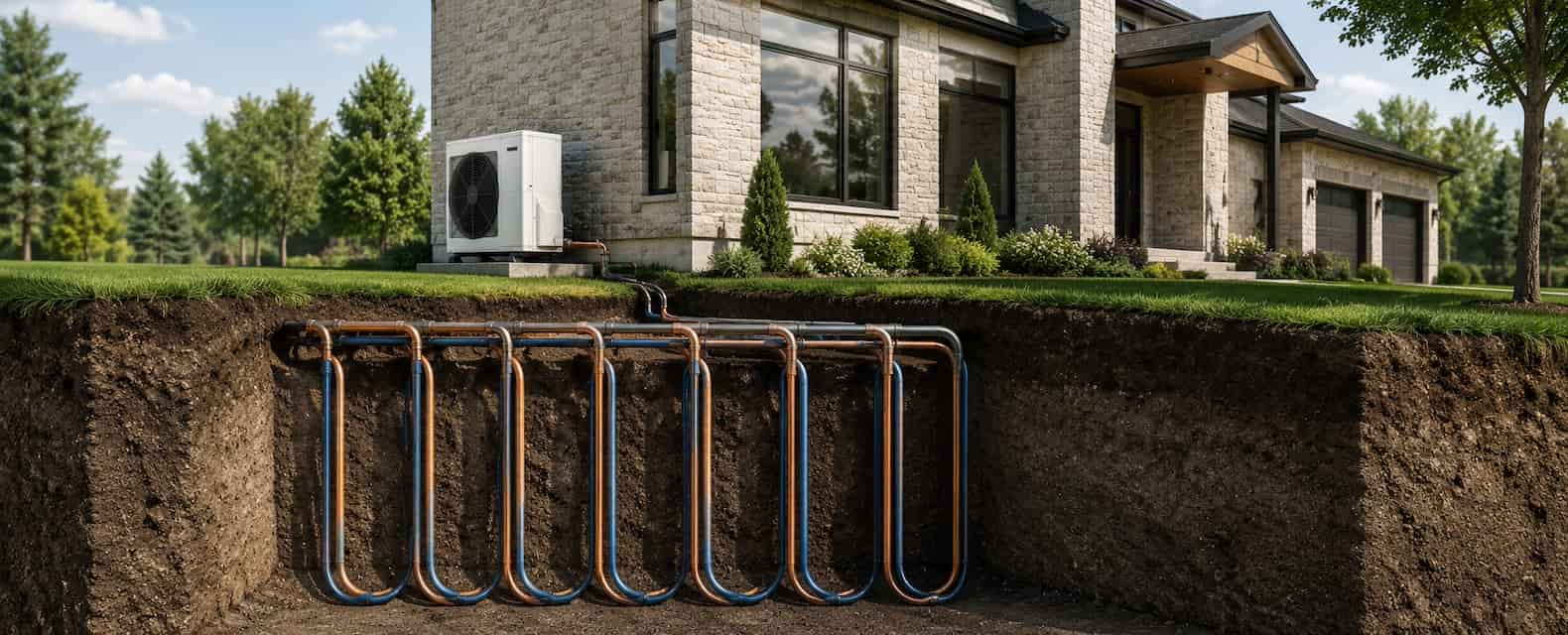
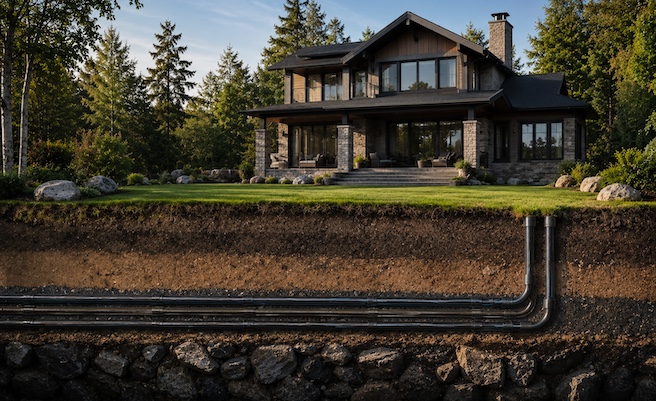
For horizontal loops, you’ll need heavy machinery for excavation. For vertical loops, you must use professional drilling equipment. Even if you rent equipment, getting the loop depth, spacing, or size wrong will permanently hurt the system’s efficiency.
Refrigerant handling is regulated
In Canada, you need certification under federal laws to work with refrigerants. It is illegal to connect or disconnect refrigerant lines without proper certification. This means you cannot do DIY repairs on any part of the heat pump’s refrigerant circuit.
Warranty requires professional installation
Most geothermal manufacturers will void the warranty on their equipment if it is not installed by a certified contractor. If you install it yourself, you could end up with an $8,000–$12,000 heat pump unit with no warranty and no manufacturer support.
Permits and inspections are required
In Ontario, you need building permits and inspections for geothermal installations. Installing a system without them can lead to issues when you sell your home. Title insurance will not cover it, and home inspectors will point it out.
The savings from installing geothermal on your own might look good on paper but can be misleading in practice. If you make mistakes, such as using the wrong-size loop or not setting up the unit correctly, you could end up spending much more than you saved on labour. Plus, you might void the warranty.
Who Geothermal Is Actually Best For
Geothermal heating and cooling can be beneficial for the right homeowner. Here’s a clear breakdown if that applies to you.
Geothermal is an excellent investment if you:
Own your home and plan to stay for 10+ years, ideally 15–20
Are currently heating with propane, oil, or electric baseboard
Are replacing both a furnace and AC at the same time (the combined replacement cost offsets the geothermal premium)
Have a property that accommodates a loop and your home is well-insulated
Want to eliminate on-site fossil fuel use entirely
Geothermal is probably not right for you if you:
Are on a tight budget and need the lowest possible upfront cost
Have a relatively new gas furnace and AC with many years of life remaining
Cannot find a qualified geothermal installer in your area
Plan to sell the house in 5–7 years, as the full ROI may not materialize by then
Have a property with significant geological or space constraints
Everything you need to know about geothermal heating and cooling in Canada — costs, incentives, installation, and whether it makes sense for your home.
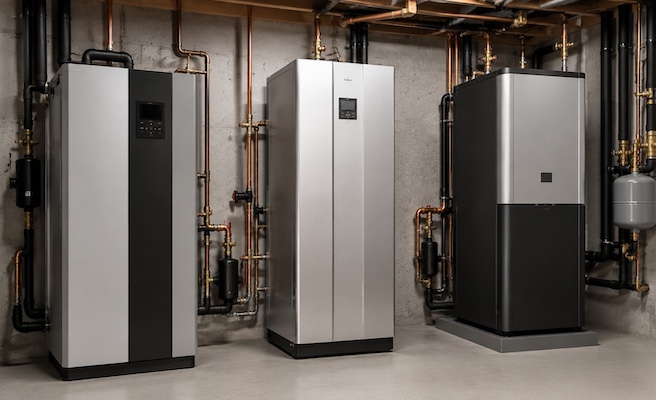
A Bosch geothermal heat pump costs $4,000 to $9,000 for the indoor unit alone, or $22,000 to $45,000 for a complete installation including ground excavation.
How much does a geothermal heating system cost?
A complete geothermal heating system typically costs $25,000 to $55,000 to install from scratch. Systems with horizontal ground loops generally cost $25,000 to $40,000 and require sufficient open land, while vertical ground loops usually cost $35,000 to $55,000 because they require deep drilling.
How much does geothermal energy cost per month?
Geothermal energy costs $100 to $150 per month for an average home, roughly 30 to 60% less than conventional oil, propane, or electric resistance heating. Actual costs depend on home size, insulation, and system sizing.
How much does geothermal energy cost per year?
Annual operating costs for a geothermal system range from $1,200 to $1,800 in electricity. This can save homeowners $3,000 to $5,000 per year compared to heating with oil or propane.
Is geothermal worth it in Ontario?
Yes, geothermal is worth it in Ontario, especially when replacing propane or oil heating systems. The upfront investment is higher, but long-term energy savings and a 20+ year equipment lifespan make it a strong long-term solution.
Is geothermal better than an air source heat pump?
Geothermal is generally more efficient and performs better during extreme cold. However, air source heat pumps cost less to install, making them a strong option for homeowners with a smaller budget.
Can geothermal heat a home at -30°C?
Yes, geothermal systems reliably heat homes at -30°C and below. They use stable underground temperatures instead of outdoor air, ensuring consistent performance during Canadian winters.
Can geothermal be used in commercial buildings?
Yes, geothermal systems are widely used in commercial buildings. They are commonly installed in offices, schools, and multi-unit residential buildings due to their efficiency and scalability.
Is geothermal maintenance expensive?
No, geothermal maintenance is typically low and cost-effective. Most components are indoors and protected from the weather, which reduces wear and service requirements compared to conventional systems
Can geothermal be installed in an older home?
Yes, geothermal can be installed in many older homes with proper system design. Most upgrades can integrate with existing infrastructure, making retrofits a practical option in many cases.
Where do we provide geothermal heat pump services?