Geothermal Heat Pumps (Ground Source Heat Pumps): How They Work & Types
You’ve likely heard of geothermal, or ground-source heat pumps. They’re among the most practical, efficient, and popular home heating and cooling options for Canadian homeowners today.
Let’s explore what a ground-source heat pump really is, how it functions step by step, what’s inside, and how it stacks up against the systems most Ontario homeowners already use.
What Exactly Is a Geothermal Heat Pump?
A geothermal heat pump, also called a ground-source heat pump (GSHP), is a heating and cooling system that uses the stable temperature below the ground to keep your home comfortable year-round.
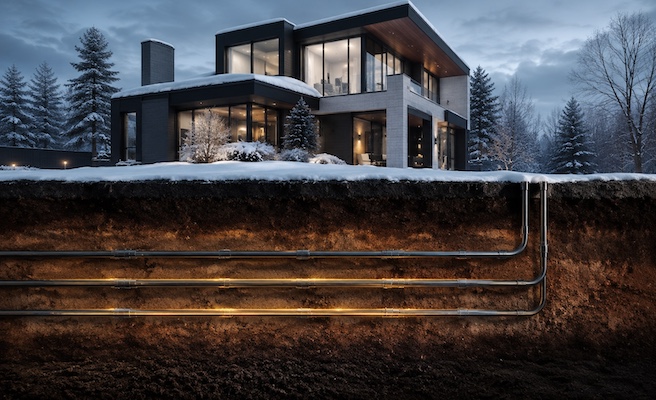
It works by circulating a heat-transfer fluid through underground pipes called a ground loop. In winter, this geothermal unit absorbs heat from the ground and moves it into your home. In summer, the process reverses, removing heat from your home and transferring it back into the ground for efficient cooling.
A geothermal heat pump doesn’t generate heat by burning fuel or using electric heating elements. Instead, it moves heat between your home and the ground. Using a refrigerant cycle and a small amount of electricity, it transfers heat indoors during winter and removes it from your home during summer.
How a Ground Source Heat Pump Works
As you already know, a ground source pump operates in two modes, namely heating and cooling. Here’s a simple look at how it works:
Heating Mode
During winter, a geo heat pump pulls heat from the ground and moves it into your home. Here’s how the process works:
Stage #1 Ground loop absorbs heat from the earth A mixture of water and antifreeze circulates through the underground ground loop. As it travels through the soil, it absorbs the earth’s natural heat and carries that energy back to the geothermal heat pump inside your home.
Stage #2 The refrigerant evaporates Inside your indoor unit, warm ground fluid flows near the cold liquid refrigerant. The refrigerant quickly absorbs heat from the fluid, causing the refrigerant to boil and turn into a low-pressure gas, while the ground fluid loops back outside.
Stage #3 The compressor raises the temperatureThe refrigerant enters the compressor as a cool gas. The compressor increases its pressure, which also raises its temperature. This creates the hot refrigerant needed to heat your home efficiently.
Stage #4 Heat is released into your homeThe hot, pressurized refrigerant gas flows through an indoor heat exchanger. As your home’s air passes over it, it absorbs the heat, causing the refrigerant to condense back into a high-pressure liquid.
Stage #5 The expansion valve resets the cycle The liquid refrigerant passes through an expansion valve, which rapidly lowers its pressure and temperature, turning it back into a cold liquid ready to absorb more heat from the earth.
Cooling Mode
In cooling mode, the system seamlessly reverses this process.
It pulls heat out of your living space and dumps it into the ground. Because underground temperatures remain consistently cool, the earth acts as a massive natural heat sink, providing highly efficient cooling even on the hottest days of the year.
Components of a Geothermal Heat Pump System
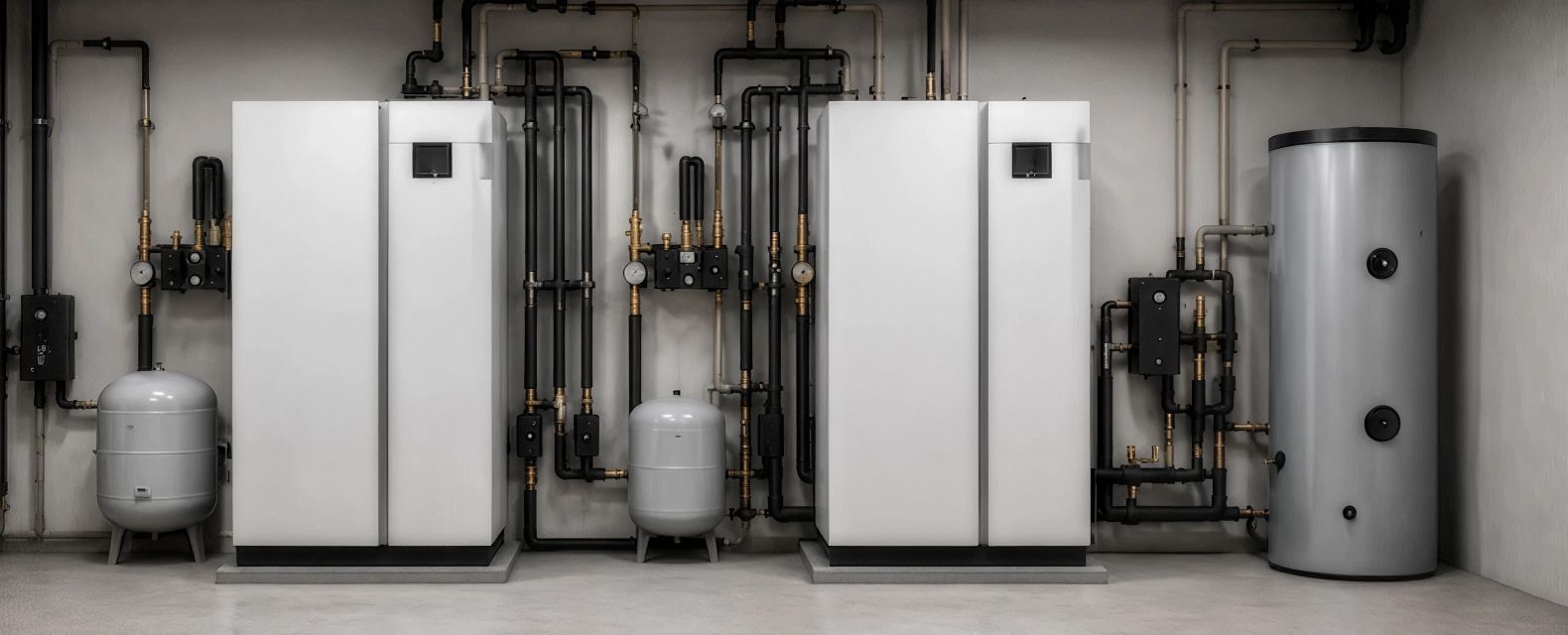
A geothermal heat pump system consists of several core components that work together to deliver efficient heating and cooling.
Component
What It’s For
Did You Know?
Ground Loop (horizontal/vertical)
Transfers heat between the ground and the heat pump by circulating a water-antifreeze mixture
An improperly sized loop will ruin the system’s efficiency, so choose a certified installer.
Ground Source Heat Pump (indoor unit)
Extracts, concentrates, and moves heat between the ground loop and your home’s distribution system
This unit lasts much longer than ordinary ACs because it is housed safely indoors, away from harsh weather
Ductwork
Distributes heated or cooled air throughout the house through the ductwork system
Leaky ducts can waste up to 30% of your geothermal energy
Communication Modules
Includes smart controls, thermostats, and zoning systems that manage system performance
Geo systems work best when keeping a steady temperature, so avoid drastic “temperature setbacks”
Accessories (flow center, pumps, valves)
Keeps the loop fluid moving through the system and helps maintain proper flow and pressure
Opt for variable-speed circulation pumps. They automatically adjust fluid flow, using less electricity
Desuperheater
Recovers excess heat from the geothermal system to heat domestic hot water
This unit gives you virtually free hot water all summer long by recycling the heat pulled out of your house
Storage System (buffer tank/desuperheater tank)
Stores heated water, improves system performance, and can provide a reserve supply of hot water
A buffer tank prevents “short-cycling”, which protects the compressor
Types of Ground Source Heat Pumps
Ground source heat pump (GSHP) systems are usually categorized in two ways: by the method they use to provide heating and cooling indoors, and by how they transfer heat to and from the ground.
These classifications are independent. For instance, a closed-loop system might use water-to-air cooling, while an open-loop system could use water-to-water cooling.
To clarify the options, geothermal heat pump heating systems can be divided into two primary categories:
By Heat Pump Type
Type
How It Works
Best Suited For
Water-to-air
Transfers heat from the ground loop into forced air, distributed through ductwork
Homes with existing forced-air ductwork
Water-to-water
Transfers heat from the ground loop into heated water for radiant floors or hydronic systems
New builds, homes with radiant floor heating
By Ground Loop Configuration
System Type
Best Suited For
Did You Know?
Horizontal Closed Loop
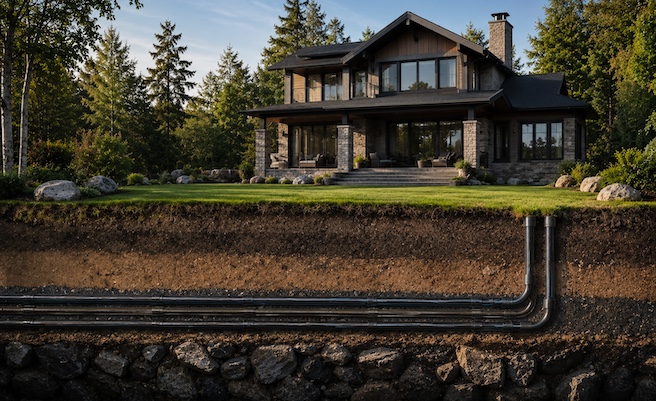
Large yards or rural properties with plenty of open acreage.
It requires long, shallow trenches and is the most affordable to install, but it temporarily disrupts your yard
Vertical Closed Loop
Suburban homes, tight lots, established landscaping
These pipes go straight down into boreholes up to 400 feet deep. They use 80% less yard space than horizontal loops
Pond/Lake Closed Loop
Waterfront homes with a deep, permanent body of water nearby
Water transfers heat faster than soil, so submerging the pipes eliminates the need for costly digging entirely
Open Loop
Properties that already have a high-volume, reliable water well.
This system draws in groundwater, removes its heat, and returns it clean
No matter which system combination you select, it will serve you well for decades by transforming the ground beneath your feet into a clean, highly efficient energy source.
Geothermal Heat Pump Efficiency: COP and EER
When evaluating a geothermal heat pump, you will constantly run into two metrics: COP (Coefficient of Performance) and EER (Energy Efficiency Ratio).
Here is the simple breakdown of what they mean and how to read them.
1. COP (Coefficient of Performance)
COP measures the system’s efficiency while it is in heating mode. It is a simple ratio of energy delivered versus energy consumed.
What it tells you: A standard geothermal system usually has a COP between 3.0 and 5.0.
Example: A COP of 4.0 means the system delivers 4 units of heat energy for every 1 unit of electricity it consumes. In terms of efficiency, that is 400%.
2. EER (Energy Efficiency Ratio)
EER measures the system’s efficiency in cooling mode (acting as a central air conditioner).
What it tells you: Unlike COP, EER is calculated using specific engineering units, namely BTUs. Geothermal systems typically have EER ratings between 20 and 30+.
Example: Traditional outdoor ACs typically have an EER of 10-14. Because the ground stays much cooler than summer air, the system doesn’t have to work nearly as hard, making it roughly twice as efficient as a standard AC.
GSHP vs. Air-Source Heat Pump
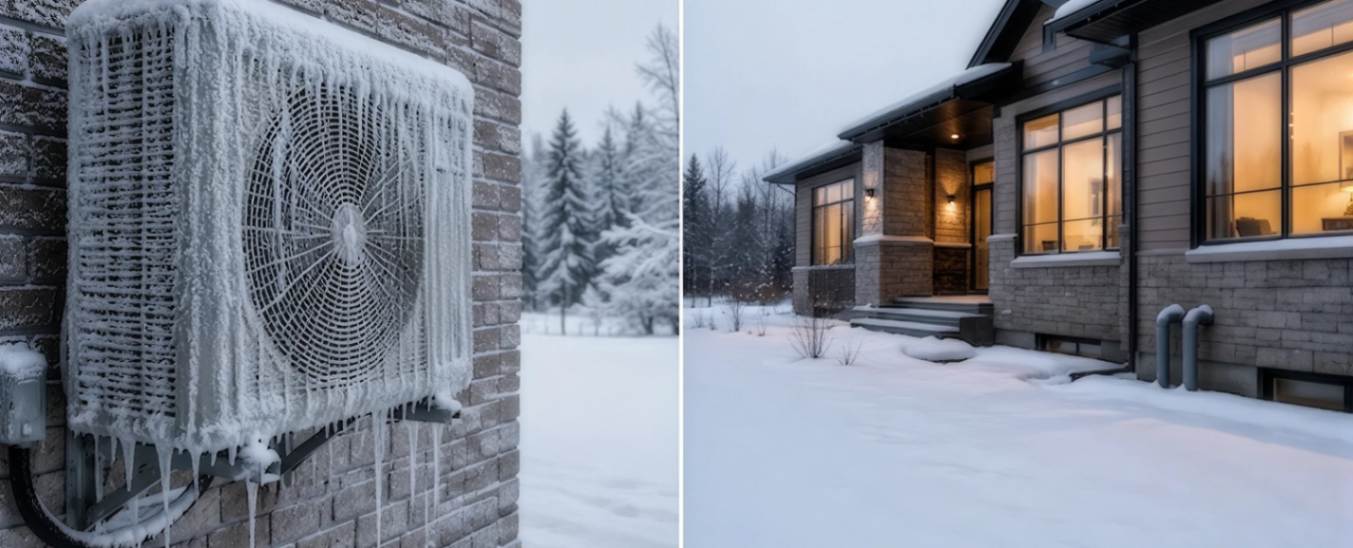
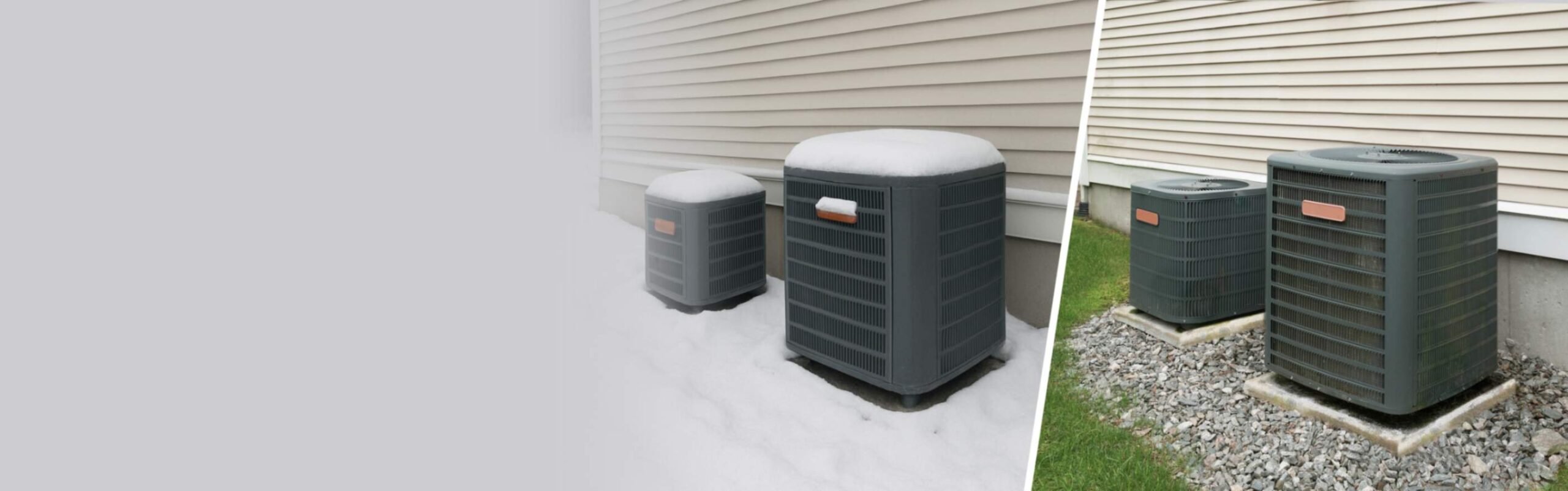
Both technologies transfer heat rather than produce it, but their main difference lies in their energy source.
Feature
Ground Source (Geothermal)
Air-Source Heat Pump
Where it gets heat
The earth (always a mild 7–10°C underground)
The outdoor air (changes with the weather)
When it hits -20°C
Deep ground temperatures remain stable regardless of the weather
The system must work harder and use more electricity
Heating COP
3.0 to 5.0 (delivers up to 500% efficiency)
1.5 to 2.5 (drops significantly in deep cold)
Cooling efficiency
Very high (ground acts as a heat sink)
Moderate (air temp rises in summer)
Upfront cost
Higher ($25,000 – $45,000+)
Lower ($8,000 – $18,000)
Installation
Requires backyard digging or drilling
Just an outdoor unit bolted outside your wall
How long it lasts
20–25 years for the indoor unit and 50+ years for the loop
15–20 years max (it sits out in harsh weather)
Maintenance
Very Low since everything important is safely indoors
Moderate since it needs clearing from snow and ice
Note: An air-source heat pump is cheaper to install and is a good option for moderate climates. However, in Ontario and most of Canada, where you need heat the most when it’s cold outside, a ground source heat pump is more efficient.
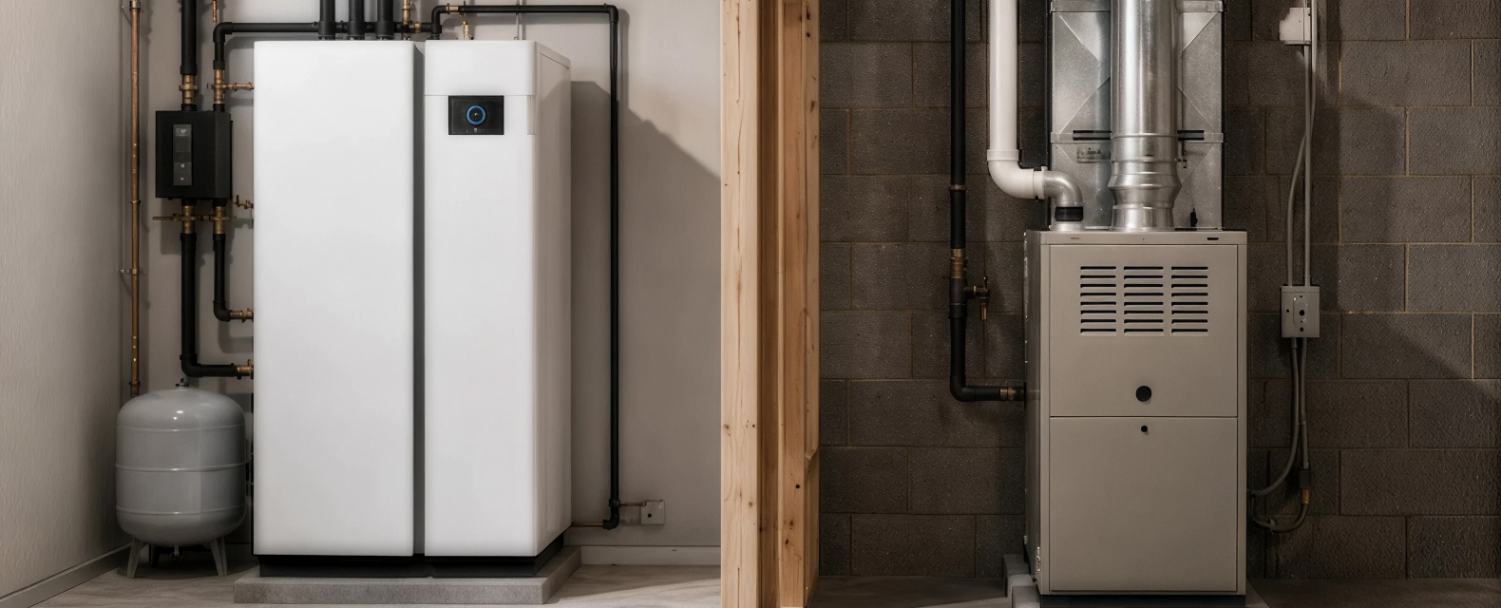
Geothermal Heat Pump vs. Gas Furnace
While both systems are designed to keep your home warm, the key difference lies in how they create that warmth.
Feature
Ground Source (Geothermal)
Natural Gas Furnace
How it heats
Moves existing heat from the ground indoors
Burns natural gas to create new heat
Heating efficiency
COP 3.0 to 5.0 (300% to 500% efficient)
AFUE 80% to 98% (maximum 98% efficient)
Cooling capability
Yes. Full central air conditioning is built right in
No. Requires a completely separate central AC unit
On-site emissions
Zero. It eats and cools without burning fuel
Produces CO₂ and NO₂ from combustion
Upfront cost
Higher ($25,000 – $45,000+)
Lower ($4,500 – $9,500 for the furnace unit alone)
Lifespan
20–25 years for the indoor unit and 50+ years for the loop
15–20 years before requiring replacement
Note: A gas furnace initially costs less to install. However, geothermal systems can be up to 400% efficient since they transfer heat rather than burn fuel. For Ontario homeowners, this can reduce yearly heating and cooling costs by 40% to 70%. Typically, it takes 10 to 15 years to recover the investment in a geothermal system.
Everything you need to know about geothermal heating and cooling in Canada — costs, incentives, installation, and whether it makes sense for your home.
What’s the difference between a geothermal and a ground source heat pump?
There is no difference. Geothermal heat pump and ground source heat pump (GSHP) are two names for the same system. Both use the stable temperature underground to heat and cool your home.
How efficient is a geothermal heat pump in Canadian winters?
A geothermal heat pump remains highly efficient even during Canadian winters because it draws heat from the ground rather than the cold outdoor air. Most systems achieve a COP of 3.5 to 5.0, meaning they produce 3.5 to 5 units of heat for every unit of electricity they use.
What is the liquid inside the pipes, and is it safe?
It’s a mixture of water and non-toxic antifreeze, typically propylene glycol or ethanol. The fluid circulates inside sealed underground pipes, never comes into contact with groundwater, and is safe when installed correctly.
What is a desuperheater, and do I really need one?
A desuperheater is an optional accessory that captures excess heat from the geothermal system to preheat your domestic hot water. While it isn’t required, it can significantly reduce water heating costs, especially during the heating and cooling seasons.
Is an open loop better than a closed loop?
Neither system is universally better. Closed-loop systems are the most common because they require less maintenance and work almost anywhere. Open-loop systems can be slightly more efficient but require a reliable supply of clean groundwater and must meet local water-use regulations.
Where do we provide geothermal heat pump services?