Types of Septic Systems and Which One Is Right for Your Property
Not every property in Ontario can run a conventional septic system. There are many “whys” for that, like lot size, soil conditions, water table depth, and proximity to lakes and rivers. They all play a role in determining what kind of system your property needs, and then you must keep in mind that the Ontario Building Code has specific classes for each.
Let’s break down the main types you’ll encounter and how to figure out which one applies to you.
Conventional Septic Systems (The Most Common Setup for Rural Homes)
What are the most common types of septic tanks? If you look at the Ontario Building Code, you’ll see five different “Classes” of wastewater systems:
Class 1 is for outhouses and composting toilets.
Class 2 is strictly for “greywater” (like your shower and sink water, but no toilet waste).
Class 3 is an old-school cesspool that is rarely approved anymore.
Class 4 is the everyday residential standard, the one we’ll talk about soon.
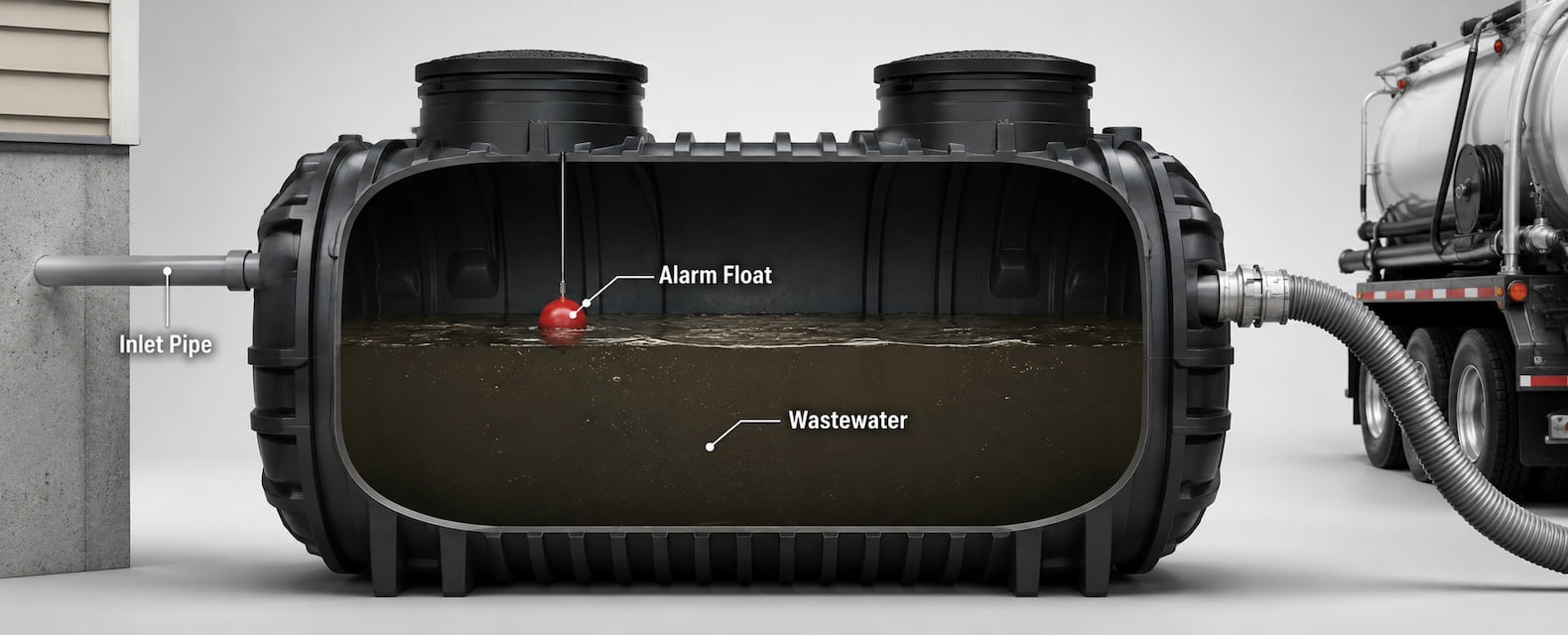
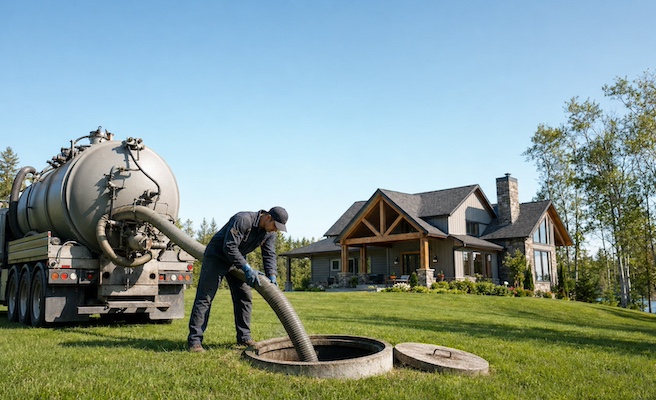
Class 5 is just a giant, sealed holding tank that doesn’t treat the water at all and needs a vacuum truck to empty it constantly.
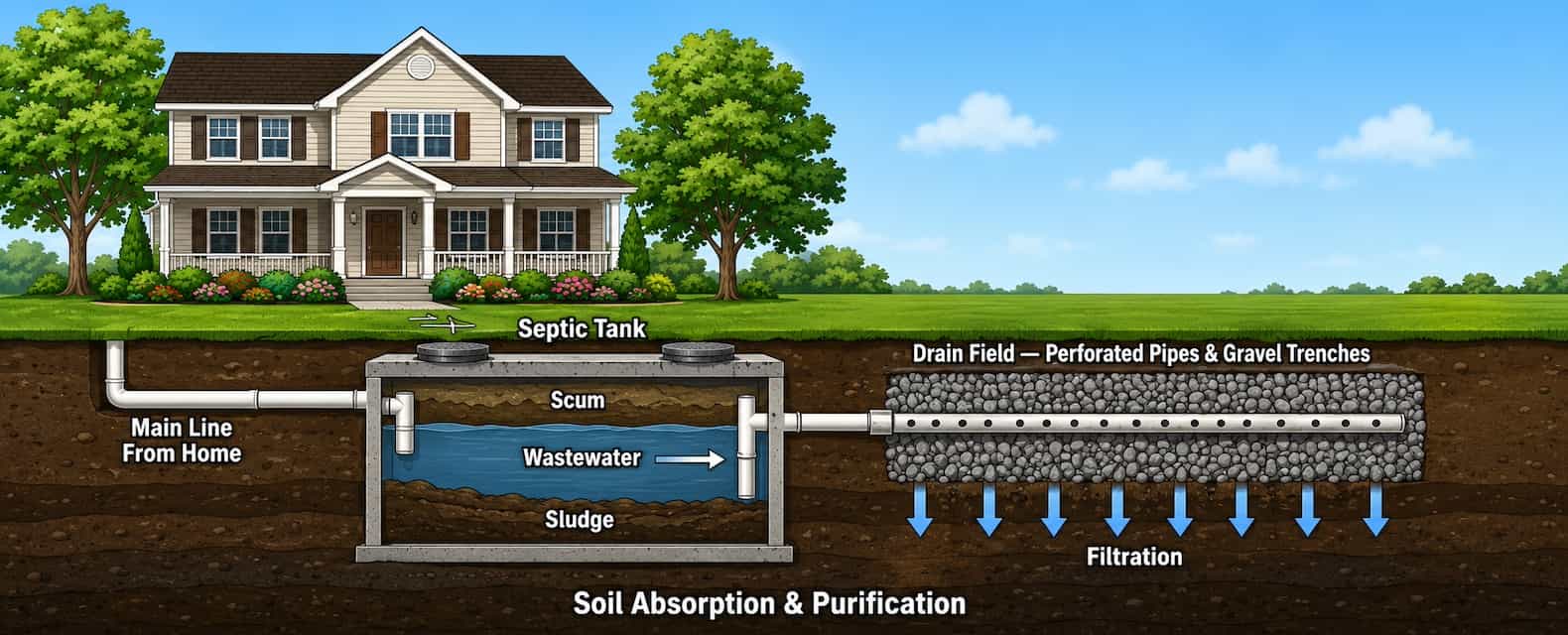
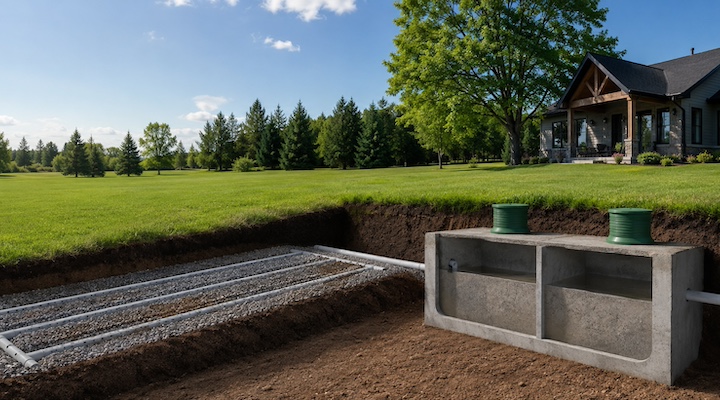
So, what exactly is a Class 4 system?Whether you live in a rural farmhouse or a lakeside cottage, you almost certainly rely on this one. A Class 4 system isn’t a “one-size-fits-all” box you buy off a shelf. Because every yard is unique, a licensed professional must custom-design your system to match your home’s water usage, the specific soil composition of your lot, and the local topography.
This is the system most people picture when they think “septic,” and for good reason: it’s the simplest, most affordable, and lowest-maintenance option available.
Factor
Conventional Septic System
What It Means For You
Treatment method
Settling tank and soil absorption
You don’t have to worry about electric bills or broken parts, because it runs entirely on gravity
Typical cost
$15,000–$22,000
You save money, as this is the most budget-friendly option to install and maintain
Maintenance
Pump every 3–5 years
You get a highly reliable system, but you still cannot skip your routine pump-outs
Best suited for
Properties with good soil percolation and adequate lot size
You must have a large, open yard with fast-draining dirt to legally install it
Lifespan
20–30+ years with proper care
You can expect it to last for decades, as long as you keep grease out of the drain and cars off the grass.
If your lot has heavy clay, shallow soil over bedrock, a high water table, or limited space for a leach field, a conventional system may not be approved by your local health unit or building department.
Aerobic Treatment Units (Systems That Use Oxygen to Clean Wastewater)
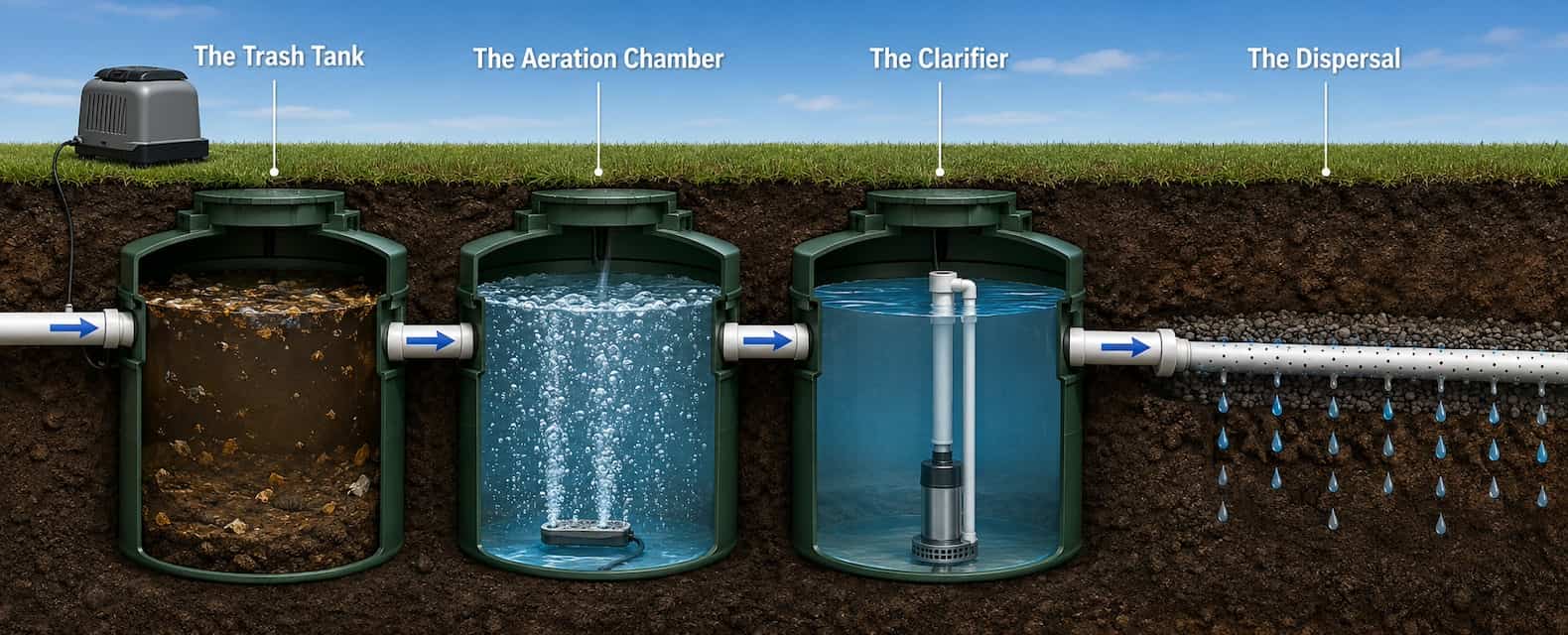
Unlike traditional setups, aerobic systems pump oxygen directly into the tank to supercharge the bacteria that break down your waste. They significantly improve wastewater treatment before discharge, but the actual treatment efficiency varies with system design, usage, and maintenance. Here is the step-by-step breakdown of how an ATU system cleans your water:
The trash tank: Just like a regular septic system, wastewater from your home enters a primary chamber. Heavy solids sink to the bottom, and grease floats to the top.
The aeration chamber: The liquid moves into a second chamber equipped with an electric air compressor. This compressor constantly bubbles oxygen into the water.
The Clarifier: The treated water then flows into a settling chamber. Any remaining bacteria or tiny solid particles sink to the bottom (and are usually recycled back to the aeration chamber for reprocessing).
The Dispersal: Because the water leaving an ATU is already clean, it doesn’t need a massive, traditional drain field. The clear effluent is safely dispersed into the soil, often through a much smaller trench network or a shallow drip-irrigation system.
Factor
Aerobic Treatment Units (ATU)
What It Means For You
Treatment method
Electric air pump and oxygen bacteria
You need a continuous power supply to run the air pump, which will add a little bit to your monthly hydro bill
Typical cost
~$25,000 – $35,000+
You will pay extra, but this lets you build a house on difficult land where standard septic systems are not allowed
Maintenance
Frequent pumping & annual mechanical inspections
You must sign an ongoing maintenance contract with a pro to regularly check the alarms, diffusers, and mechanical parts
Best suited for
Small lots, waterfronts, or poor soil (clay/rock)
You can safely build that dream home or cottage even if your yard is tiny, sits on shallow bedrock, or is right next to a lake
Lifespan
20–30+ years (for the tanks themselves)
You will get decades out of the heavy tanks, but budget to replace the electric air compressor every 5 to 10 years
Aerobic systems suitable for properties with poor soil, tight spaces, or tricky site conditions where a standard conventional system just isn’t an option.
Holding Tanks (A Temporary Storage Solution for Wastewater)
A holding tank is not a treatment system but a storage container. Wastewater flows in and stays there until a licensed waste hauler pumps it out and takes it away. There is no leach field, no soil absorption, and no on-site treatment at all. Holding tanks are regulated as Class 5 systems in Ontario and are typically only approved as an absolute last resort when no other option is feasible. For example, on tiny waterfront lots with no room for a drain field, or as a temporary solution while a permanent system is being installed.
Factor
Holding Tank
What It Means For You
Treatment method
Absolutely none (100% storage only)
You are not cleaning or filtering the wastewater; instead, you keep it in a giant underground vault
Typical cost
~$5,000 – $10,000
You save money on installation, but you will pay hundreds of dollars every month for a vacuum truck to haul the waste away
Maintenance
Constant commercial pumping
You are completely dependent on a local pumping service, and you must never ignore the high-water alarm
Best suited for
Extreme situations (tiny lots, solid rock)
It is an absolute last resort. You should only use this if the Ontario Building Code legally prevents you from installing a drain field.
Lifespan
20–30+ years for the tank itself
The thick concrete or plastic tank will last for decades, but the expensive cycle of constant pumping will never end.
Because pumping costs add up quickly, you may need pumping every few weeks. Many Ontario municipalities also require an alarm system that alerts you when the tank is nearing capacity, since an overflow is both a mess and a regulatory violation.
Above-Ground / Mound / Alternative Septic Systems (When a Standard System Won’t Work)
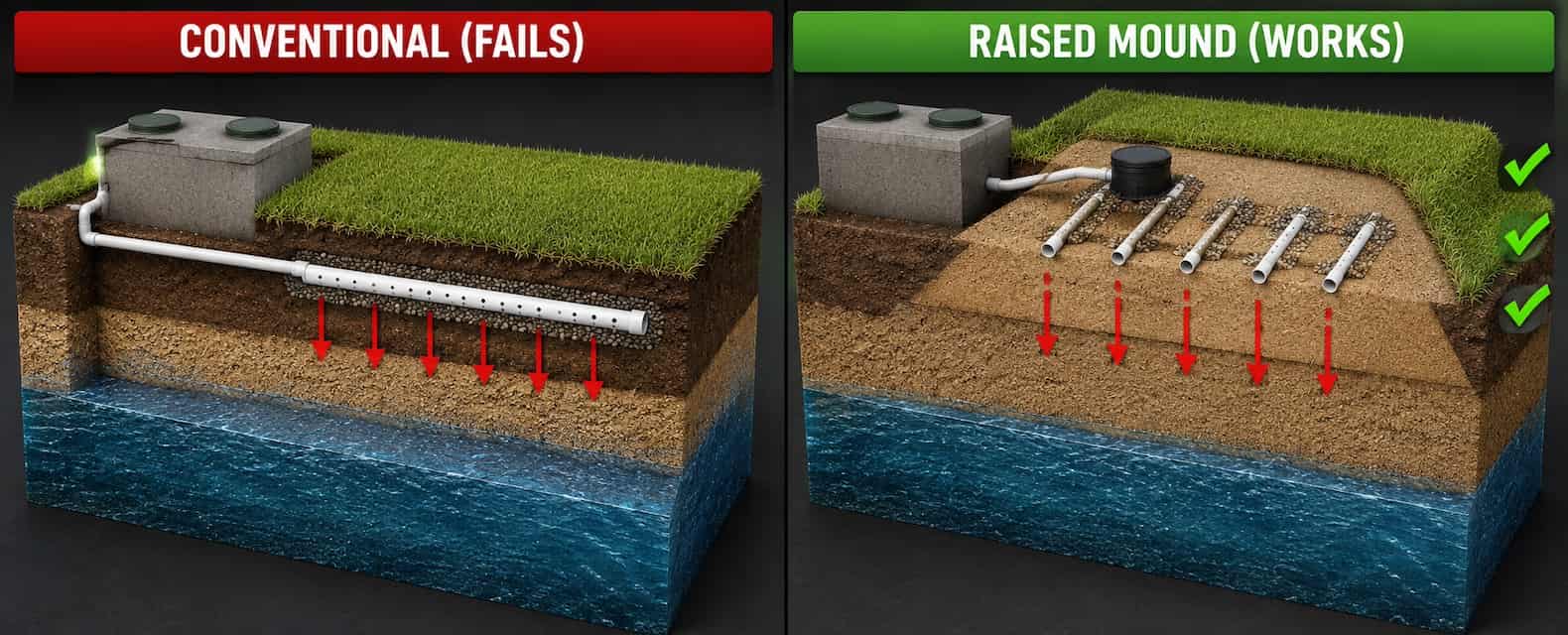
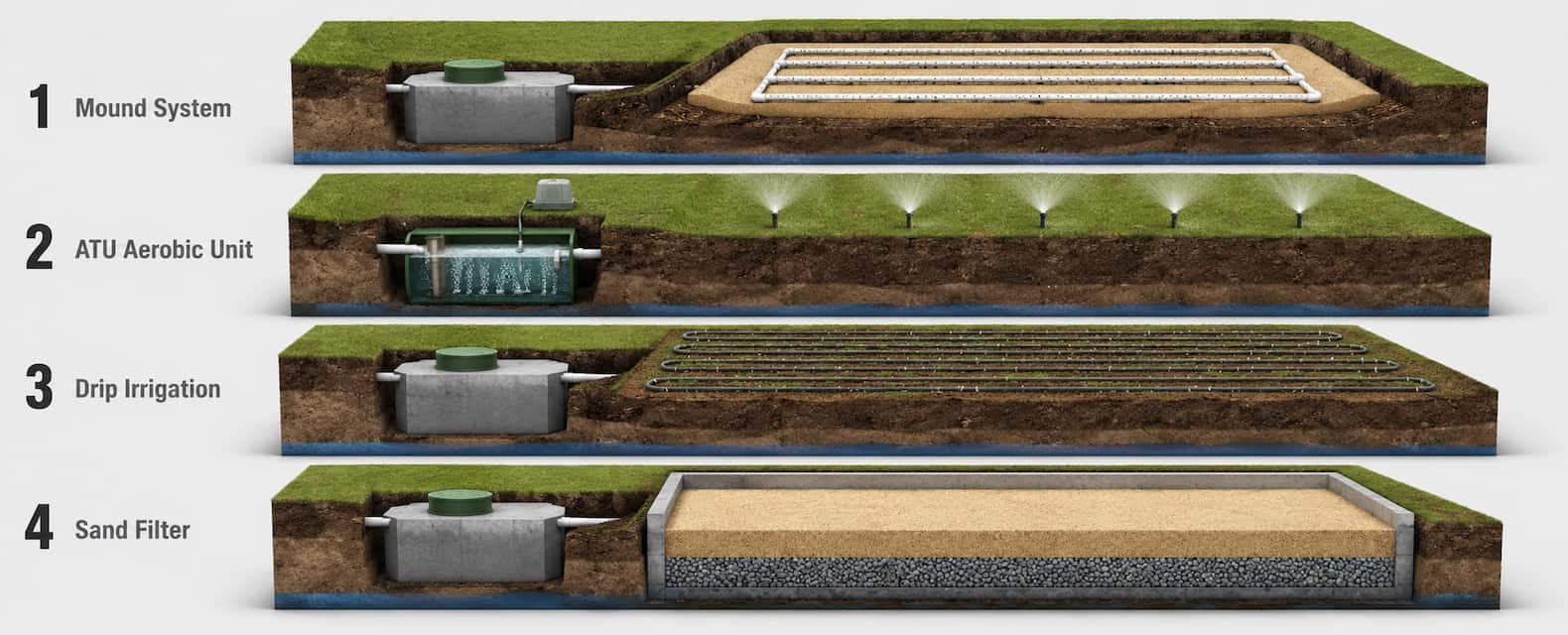
When soil conditions, water table depth, or the proximity of bedrock make it impossible to use a buried leach field, Ontario’s Building Code allows several Class 4 alternatives. You can install an alternative above-ground septic system by obtaining approval from the local authority responsible for enforcing the Code, such as a municipality, health unit, or conservation authority. These systems are typically considered alternative solutions and must demonstrate performance equal to or better than conventional Code-approved systems. In some cases, additional approvals under the Ontario Water Resources Act may be required through the Ontario Ministry of the Environment, Conservation and Parks.Here are common septic tank alternatives used in areas where a traditional system is not suitable:
1. Mound Systems (Raised Beds)
A mound system is often used when a property has a high water table, shallow bedrock, or soil conditions that make a conventional drain field impractical. Here’s how a mound system cleans your water:
The septic tank: Like a conventional system, wastewater first enters a septic tank, where heavy solids settle to the bottom, and grease and oils float to the surface. The partially clarified liquid remains in the middle.
The pump chamber: Because the treatment area is elevated, the effluent flows into a separate chamber equipped with an electric pump, which sends measured doses of wastewater up to the mound.
The mound: A network of small pipes distributes the effluent through layers of engineered sand and gravel. These materials provide the filtration and oxygen needed to treat the wastewater.
The final dispersal: After passing through the mound, the treated water gradually moves into the native soil below, where it continues to undergo natural purification.
2. Raised or Shallow-Buried Systems
These use a principle similar to the mound system, but on a much smaller scale. It provides the necessary soil depth without creating a massive, highly visible hill in your yard.
Factor
Mound / Raised Systems
What It Means For You
Treatment method
Engineered sand filtration and an electric pump
It filters waste naturally like a conventional system, but relies on a mechanical pump to push the water uphill
Typical cost
$22,000–$38,000+
You are paying for the heavy machinery and dozens of dump trucks needed to haul in specialized sand and soil
Maintenance
Pump every 3–5 years & monitor pump chamber
The mound itself is low maintenance (just mow the grass), but the electric pump requires periodic checks
Best suited for
High water tables, shallow bedrock, or heavy clay
It’s the ultimate problem-solver for challenging land where standard buried trenches are illegal
Lifespan
20–30+ years (for the mound itself)
The raised bed will last decades if properly maintained, but budget to replace the electric pump eventually
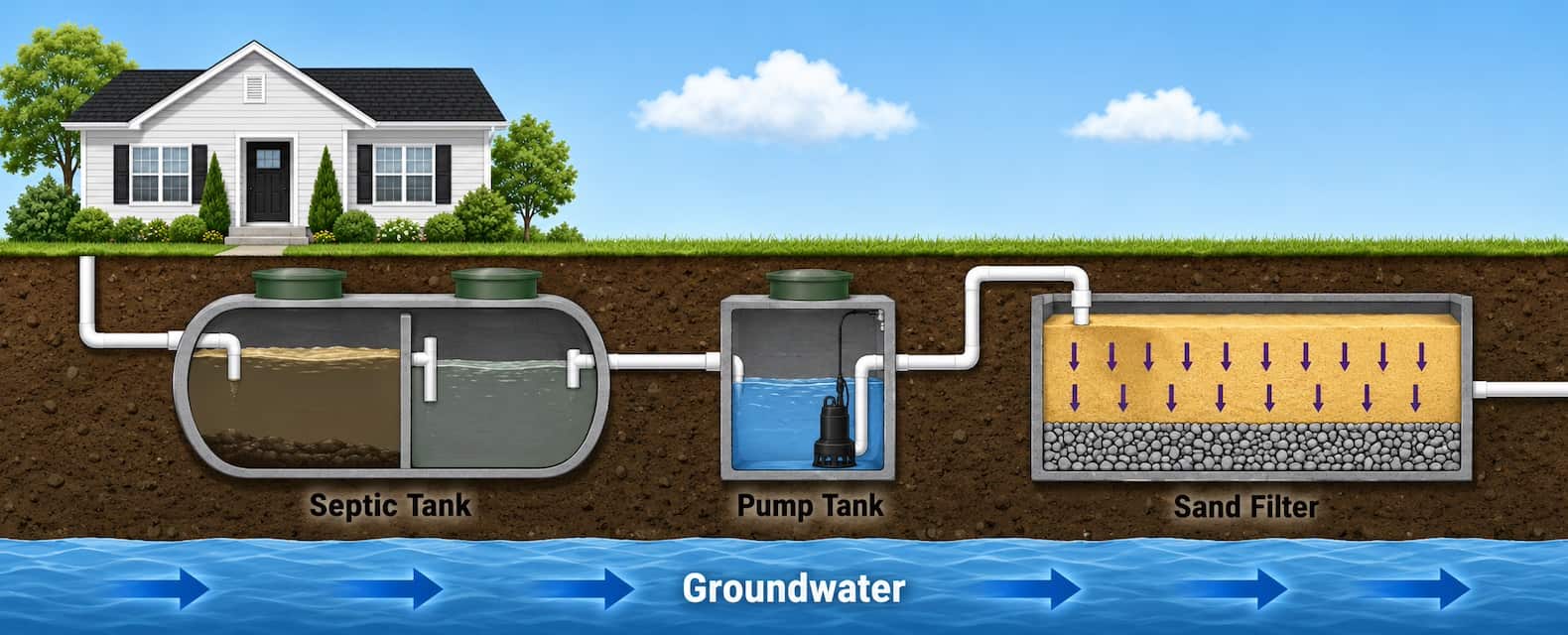
3. Sand Filter Systems (Filter Beds)
Since soils in Ontario are frequently too hard, too wet, or you are living in an area surrounded by solid rock (such as the Canadian Shield), a conventional buried system is often impossible. The Ontario Building Code allows Sand Filter Systems—often called Filter Beds—to address this problem. These beds can be built upon heavy clay, solid rock, and high groundwater tables, or used on lots with tight property lines and mature trees. To do this, you must bring in a lot of specialized sand and essentially build a compact, highly engineered “sandbox.”
Factor
Sand Filter Systems (Filter Beds)
What It Means For You
Treatment method
Engineered sand bed filtration (Gravity or Pumped)
It uses a highly concentrated, custom-built sandbox to provide a high level of nutrient treatment
Typical cost
~$14,000 – $25,000
It costs more than a conventional system because the specialized “filter sand” is expensive and must be hauled in by dump trucks
Maintenance
Pump every 3–5 years & monitor pump
It requires regular tank pumping since overloading the system with water can cause it to fail prematurely
Best suited for
Solid rock, heavy clay, high water tables, or tight lots
It is a great space-saver and problem-solver for tricky Canadian Shield properties or lots near lakes
Lifespan
15–25 years (Vulnerable to early failure)
Because waste is highly concentrated, heavy biomat growth can cause the sand filter to clog faster than a sprawling conventional system
Filter bed systems require detailed hydraulic calculations by a qualified designer, and must use engineered sand media that meets approved gradation and performance standards under the Ontario Building Code and local authority requirements.
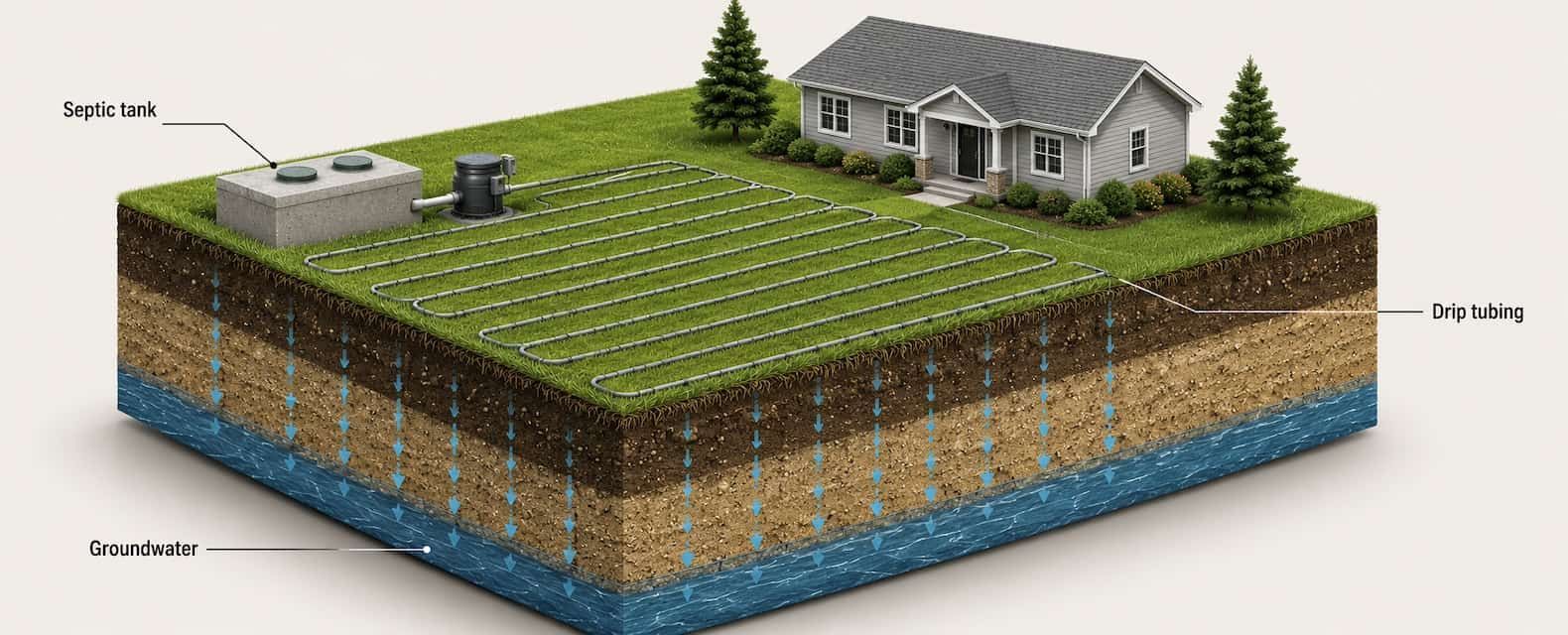
4. Drip Dispersal Systems
What if your property isn’t just small but also located on a steep, heavily wooded hill or has incredibly shallow soil? A conventional trench won’t work, and a massive raised mound would ruin your landscaping. The drip dispersal system provides a slow, even distribution of treated wastewater across the soil. Wastewater first flows from the home to the septic tank and then passes through an advanced treatment unit for additional purification. The effluent is then pumped through a network of small-diameter pipes installed near the surface, where it is gradually released into the soil. As the water is absorbed, plants and microorganisms help recycle nutrients and complete the treatment process.
Factor
Drip Distribution Systems
What It Means For You
Treatment method
Advanced Treatment & Low-Pressure Dosing
It often requires an advanced pre-treatment unit (like an ATU) before the water is slowly pulsed into the shallow topsoil.
Typical cost
~$30,000 – $60,000
You are paying for advanced treatment tanks, high-head pumps, computerized panels, fine filters, and specialized tubing.
Maintenance
Inspection visits 1–2 times per year
You must have a professional regularly check the computer panel, clean the fine filters, and flush the drip lines to prevent clogs.
Best suited for
Steep slopes, heavily wooded lots, and shallow soil
It is incredibly flexible and requires very little excavation, making it perfect for lots where heavy machinery can’t operate.
Lifespan
15–25+ years (with strict maintenance)
The tubing itself lasts a long time, but the pumps, filters, and electronic control panels will require eventual replacement.
These systems need a site evaluation by a qualified designer. You usually must submit engineered drawings with your building permit application. This is not something a standard installer can do by just looking at it.
How to Choose the Right Septic System for Your Property
The right system isn’t really a choice — it’s determined by your lot. Here are the main factors that will drive your final decision:
Soil percolation rate. Perform a percolation test (perc test) to measure how quickly your soil absorbs water. Poorly draining clay soils often rule out conventional systems and push you toward a sand filter or an ATU.
Depth to bedrock or water table. In rural and cottage-country Ontario, a common problem is shallow bedrock or high groundwater. This makes it hard to dig deep for septic systems. As a result, you need to use a mound system or a raised bed to create extra depth.
Proximity to lakes, rivers, or wetlands. The Ontario Building Code requires minimum separation distances from wells, property lines, and water bodies. Small or irregular lots simply may not fit a sprawling conventional field, making a compact Sand Filter or ATU necessary.
Topography and landscaping: Steep slopes, rocky terrain, or limited access for excavation equipment can influence system design. In some cases, engineered solutions like Drip Distribution Systems may be used where conventional layouts are not practical.
Power reliability: Systems that rely on pumps or aeration, such as ATUs and mound systems, require reliable electricity. Properties with limited or inconsistent power may be better suited to simpler gravity-based designs where conditions allow.
Budget (upfront vs. ongoing): Conventional systems are the cheapest to install and maintain. Alternative systems (like mounds and ATUs) cost significantly more upfront to install.
Comparison Of All Types Of Septic Systems
Make sure that both the installer and the product manufacturer approve the installation. In Ontario, installers need the proper qualifications, including a valid Building Code Identification Number (BCIN).
Keep all permits, approvals, and service agreements together in a secure place.
Maintain an accurate, up-to-date record of all pumping, maintenance, and repairs.
If you sell your home, ensure the new owners fully understand the system’s ongoing maintenance and contract needs.
Ask the manufacturer for proper procedures before turning off power for the winter.
Always verify that pumps and air compressors restart properly after a power failure.
Navigating Ontario’s septic regulations can feel overwhelming, but you don’t have to handle it alone! Hire a licensed septic designer or engineer to conduct soil tests, check your property’s setbacks, and do the math to find the right system for your needs. With the right team, you can relax knowing your system will keep your property clean, safe, and up to code for many years!
The 3 most common septic systems are conventional systems, chamber systems, and mound systems. Each is designed for different soil conditions, site layouts, and wastewater treatment needs.
How to tell what type of septic system you have?
You can tell what type of septic system you have by reviewing your property records, septic permit, or installation drawings, or by having a professional inspection. The tank layout and drain field design quickly reveal the system type.
What are the types of septic systems?
The most common septic system types include conventional, chamber, mound, aerobic treatment units (ATUs) and sand filter systems. The right design depends on soil percolation rates, lot sizing, and local water tables.
What is the best type of septic system?
A conventional gravity septic system is the best type if your property has deep, well-draining soil because it requires zero electricity and minimal maintenance. For properties with poor soil or high water tables, an aerobic treatment unit (ATU) is best because it purifies water to near-potable standards.
What type of laundry detergent is best for septic systems?
The best laundry detergent for septic systems is a liquid, biodegradable, low-phosphate, and low-surfactant formula. These products reduce buildup inside the tank and help protect beneficial bacteria.
What type of septic system do I have?
The easiest way to determine your septic system type is by checking your septic permit or having the system professionally inspected. Tank configuration and drain field design identify the specific system.
What’s the difference between a conventional tank and an aerobic system?
A conventional septic tank uses natural, passive bacteria to break down waste slowly. An aerobic system introduces oxygen into the treatment process, allowing fast-acting bacteria to produce significantly cleaner effluent before it reaches the drain field.
Are aerobic septic systems worth the extra cost?
Yes, aerobic systems are worth it in areas with poor soil, small lots, or environmental restrictions. They are often required in challenging sites, while conventional systems remain the most cost-effective option where conditions allow.
Can I install my own septic system in Ontario?
No, septic system installation in Ontario must be completed by a licensed professional under permit approval. DIY installation is not permitted and violates provincial building regulations.
Do I need a permit to upgrade my system?
Yes, any septic system upgrade or modification requires a permit and approval from the local building authority. This includes site evaluation and compliance with current building code requirements.