

 Call us and we’ll come to you





What Ontario Homes and Buildings Need From an Electrician
Ontario has a lot of older housing stock, and the electrical systems inside it were built for a different set of appliances. Much of the work we do comes down to a handful of recurring situations.

Aluminum wiring. Houses wired between roughly 1965 and 1978 often have aluminum branch circuits. The wiring itself is not automatically a hazard, but the connections at outlets, switches and the panel can loosen and overheat over time. Insurers frequently ask about it and sometimes require remediation. We inspect the terminations and pigtail the connections with approved connectors where that’s the right fix.
Knob-and-tube wiring. Pre-1950s homes in Toronto, Ottawa, Hamilton and Kingston still have knob-and-tube in walls and attics. It has no ground conductor, and many insurers will not write a policy until it’s replaced. We assess how much is still live and quote the rewiring in stages if a full rewire isn’t practical right now.
Older panels. Some panel models installed in Canadian homes decades ago have a history of complaints about breakers that don’t trip reliably, and a fuse box gives you no ground fault or arc fault protection. If your panel is original to a house built before the 1980s, it’s worth having it looked at.
60-amp service. A 60-amp service was normal when a house had a stove, a fridge and a few lights. Add a heat pump, central air, an EV charger or a basement suite and the service simply runs out of capacity. Upgrading to 100 or 200 amps is often the first step before any other electrical work makes sense, and many insurers now expect at least 100 amps.
ESA permits and inspection. Most electrical work in Ontario requires a notification filed with the Electrical Safety Authority before it starts. Once the work is done, ESA inspects it and issues a Certificate of Acceptance. That certificate is what a buyer’s lawyer, an insurer or a building department asks for later. We file the notification, meet the inspector on site and hand you the paperwork when it’s issued.
Warning Signs You Should Call an Electrician
Not every electrical symptom is an emergency, and not every one can wait. Here’s how we’d sort them.
Shut off the circuit and call us today
A burning or hot plastic smell near an outlet, switch or panel. Sparks when you plug something in. Scorch marks or melted plastic on a receptacle. Smoke of any kind. If you can safely switch off the affected breaker, do it and call us. These are signs of arcing or overheating inside the wall.

Book service this week
Breakers that trip repeatedly. A breaker that trips once in a while may be reacting to a temporary overload. The same breaker tripping over and over means either the circuit is carrying too much, or something on it has failed.
Outlets or switches that feel warm. Outlets should stay at room temperature. Heat usually means a loose connection or a load the circuit wasn’t built for.
Buzzing or crackling. A hum from a panel, outlet or fixture points to loose terminations, a failing breaker or arcing.
Dead outlets that keep coming back. One dead outlet is often just a tripped GFCI. An outlet that dies again after you reset it has a wiring or circuit problem behind it.
Plan an upgrade
Lights that dim when equipment starts. Voltage drop when the dryer, AC or a shop tool kicks in usually means the circuit or the service is undersized.
Part of the property losing power. If one area repeatedly goes dark while the rest stays on, the issue is in that circuit, its breaker or the distribution equipment feeding it.
A fuse box or 60-amp service. Nothing may be failing today, but you’ll hit the ceiling the moment you add an EV charger, a heat pump or a finished basement.
How Our Electricians Diagnose and Repair Electrical Problems

Replacing the first component that looks damaged is guesswork. Our process is built around finding the cause and proving the fix worked.
1. Electrical inspection
The electrician looks at the affected area, the panel, the circuits involved and any equipment connected to them. Visible wiring, breakers, outlets, switches and terminations get checked.
2. Testing and diagnosis
We use proper test equipment to locate the fault: voltage and load readings, continuity, grounding, circuit protection and the condition of connections. This is what separates a real diagnosis from a guess.
3. Written price, then repair
Before any work starts, the electrician explains what’s wrong, what the options are and what each one costs. Nothing proceeds until you approve the price. The repair may involve fixing wiring, replacing a breaker, adding a circuit, changing a device, upgrading equipment or correcting unsafe connections.
4. Testing and ESA inspection where required
Every circuit and component we touched gets re-tested before we leave. When the job required an ESA notification, we’re on site for the inspection and you receive the Certificate of Acceptance for your records.
Electrical Services for Homes, Businesses and Industrial Propertie
A century home, a restaurant kitchen and a warehouse ask completely different things of an electrical system. Our approach changes with the load and the equipment.
Residential electrical services
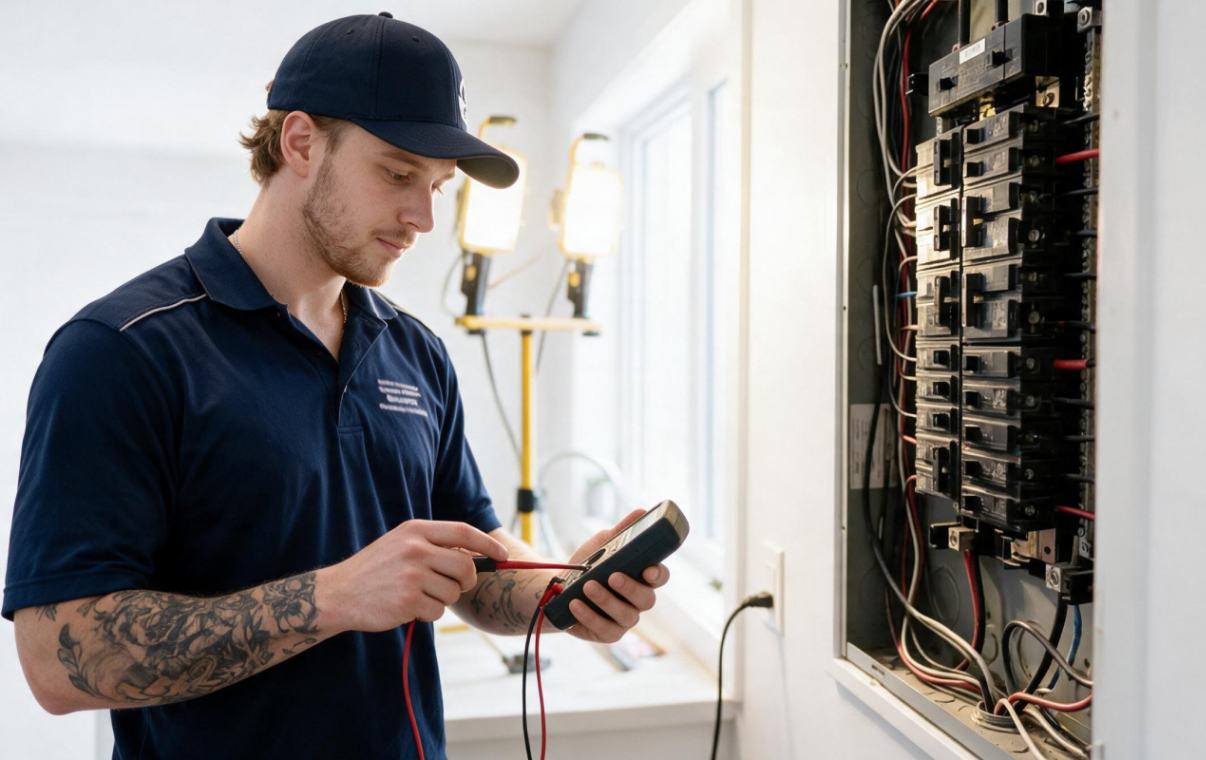
Homeowners call us for the small things that stopped working and for the bigger projects that need planning.
- Panel and service upgrades, including 60A to 100A or 200A
- Aluminum wiring assessment and pigtailing
- Knob-and-tube replacement
- Rewiring for renovations, additions and basement suites
- EV charger circuits
- Dedicated circuits for ranges, dryers, hot tubs and workshops
- Pot lights, outdoor and landscape lighting
- Outlet, switch and dimmer installation
- GFCI and AFCI upgrades
- Whole-home surge protection
- Hardwired smoke and CO alarms
- Electrical inspection before buying or selling
Commercial electrical services

For a business, the cost of an electrical problem is measured in hours closed, not in parts. We work around your operating schedule and keep the building compliant.
Offices, retail, restaurants and commercial kitchens, medical and professional facilities, multi-unit residential buildings, warehouses and shops.
- Fast troubleshooting to limit downtime
- Panel, subpanel and distribution work
- Circuits for kitchen and production equipment
- Commercial lighting, retrofits and lighting upgrades
- Emergency lighting and exit signage
- Tenant improvement and fit-out electrical
- Code compliance work and deficiency correction
- Scheduled after-hours service
Industrial electrical services
Industrial sites run larger loads, three-phase equipment and machinery that can’t be down long.
- Electrical distribution and industrial panels
- Three-phase power and equipment circuits
- Motors, starters and controls
- Disconnects and transformers
- High-bay and facility lighting
- Machine connections and relocations
- Fault finding on production equipment
- Preventive electrical maintenance programs